July 7, 2026
Filing a Detroit Labor Law Claim: A Step-by-Step Guide for Employees
Learn how to file a Detroit labor law claim for unpaid wages, discrimination, or retaliation with this step-by-step guide.

Learn how to file a Detroit labor law claim for unpaid wages, discrimination, or retaliation with this step-by-step guide.

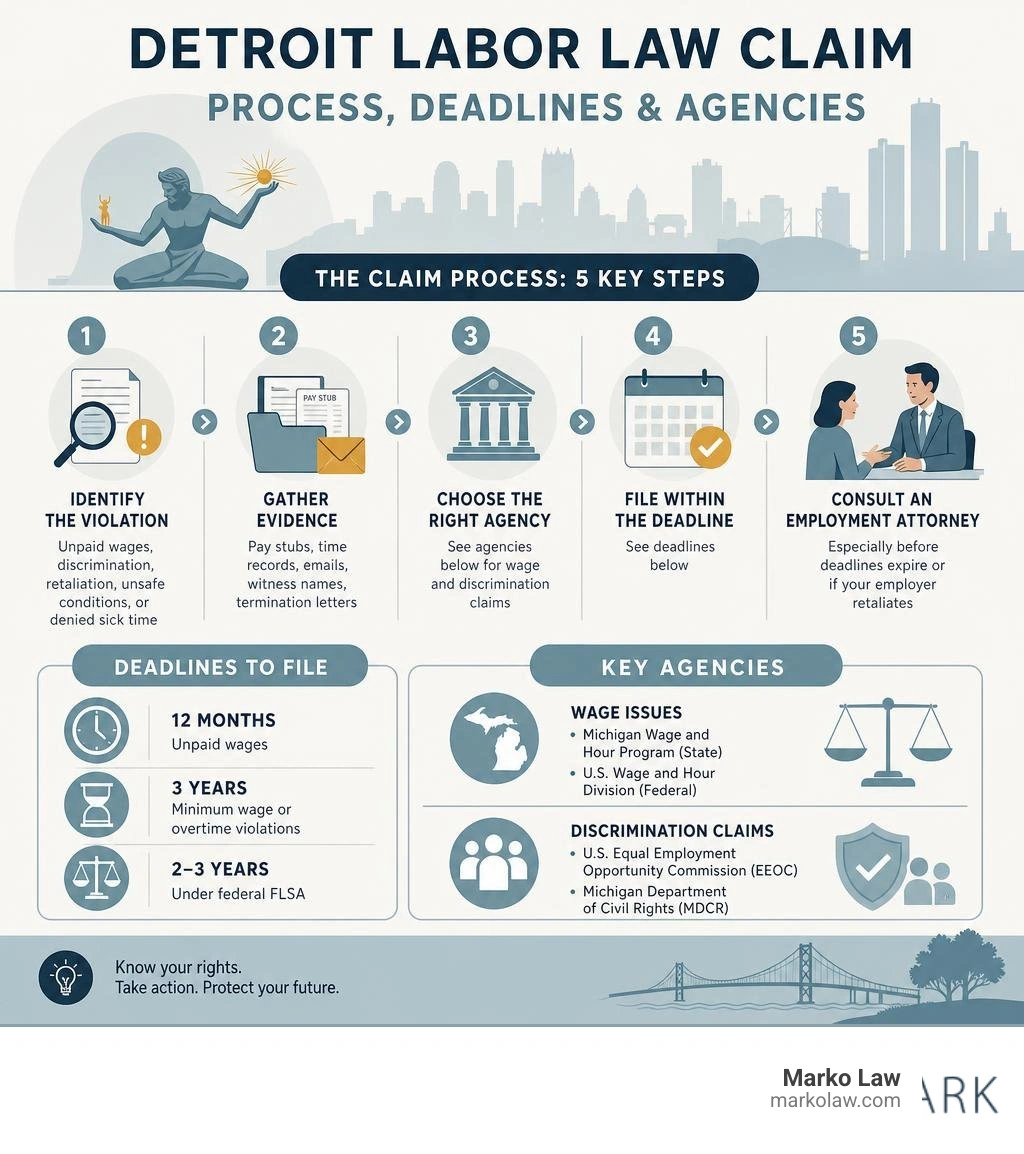
Filing a Detroit labor law claim is your legal right when an employer violates wage laws, discriminates against you, or retaliates for speaking up. Here's a quick overview of how the process works:
How to file a Detroit labor law claim:
You showed up. You did the work. And your employer still didn't pay you what you earned — or fired you for speaking up, or treated you differently because of who you are.
That's not just wrong. In Michigan, it's often illegal.
Detroit workers are protected by a layered system of state and federal laws. These include Michigan's Wage and Fringe Benefits Act, the Elliott-Larsen Civil Rights Act, the federal Fair Labor Standards Act (FLSA), and newer protections like the Earned Sick Time Act that took effect in February 2025. When employers violate these laws, workers have real options — and real deadlines to act.
The problem? Most people don't know where to start. The paperwork feels overwhelming. The power imbalance feels impossible. And the fear of retaliation is real.
This guide walks you through every step — from understanding your rights to filing your claim and knowing what to expect.
Navigating the landscape of employment law can feel like trying to read a map of Detroit during a heavy snowstorm. There are federal rules, state statutes, and local ordinances, all overlapping. Knowing which law applies to your situation is the first step in successfully resolving a Detroit labor law claim.
At the federal level, the Fair Labor Standards Act (FLSA) sets the baseline for minimum wage, overtime pay, and child labor standards. Meanwhile, state-level protections are enforced by agencies like the Michigan Department of Labor and Economic Opportunity (LEO). You can explore their official resources on the Workplace Rights - LEO - State of Michigan portal.
In many cases, Michigan state laws offer stronger protections than federal standards. When state and federal laws differ, employers must follow the standard that is most favorable to the employee. For a deeper dive into day-to-day workplace protections, read our guide on Michigan Labor Law Breaks: Know Your Rights as a Worker.
To help you visualize how these different legal frameworks interact, here is a comparison of Michigan state versus federal labor standards as of July 2026:
Like most states, Michigan operates under the "at-will" employment doctrine. This means that, in the absence of a written contract or collective bargaining agreement, either you or your employer can terminate the employment relationship at any time, for any reason, or for no reason at all.
However, "at-will" does not mean "anything goes." Your employer cannot fire you for an illegal reason. Michigan courts recognize three specific, narrow public policy exceptions to the at-will doctrine. You cannot be legally discharged for:
If you are fired for any of these reasons, you may have grounds for a wrongful termination lawsuit, even if your employee handbook states that your employment is strictly at-will.
Wage theft is one of the most common workplace violations in Detroit. Under Michigan law, the state minimum wage rose to $12.48 per hour in 2025 and has increased to $13.75 per hour as of January 2026.
For workers who receive tips, the rules are highly specific. Tipped employees can be paid a lower cash wage, but only if their direct wages plus tips equal at least the state minimum wage. If you are wondering about the exact mechanics of this rule, check out our answer to Can My Employer Pay Me Less Than Minimum Wage If I Am a Tipped Employee.
Overtime is another frequent battleground. Under both state and federal law, non-exempt employees must receive overtime pay at a rate of 1.5 times their regular hourly rate for all hours worked over 40 in a single workweek. Many workers ask us, "Am I Entitled to Overtime Pay If I Work More Than 40 Hours a Week?" The answer is almost always yes, unless you fall into a legally defined "exempt" category.
To understand whether you qualify for overtime, you must understand the legal boundary between salary and hourly workers. We break this down in detail in our article on What Is the Difference Between a Salary and an Hourly Employee. Simply paying an employee a flat salary does not automatically make them exempt from overtime; they must also perform specific professional, executive, or administrative duties as defined by law.
Furthermore, Michigan employers are legally required to maintain accurate payroll and time records for at least three years. These records must detail your hours worked, pay rates, deductions, and fringe benefits. If your employer fails to keep these records, it makes it much easier for your attorney to establish wage violations in court.

The legal landscape for Detroit workers has shifted dramatically over the last year. Keeping up with these changes is essential if you are planning to file a Detroit labor law claim.
Two major shifts stand out: the implementation of the Earned Sick Time Act (ESTA) and the historic repeal of Michigan's "Right-to-Work" law. Both changes have restored significant power to employees and labor unions across Wayne County.
Effective February 21, 2025, the Earned Sick Time Act transformed how time off is handled in Michigan. Under ESTA, most Michigan employers are required to provide at least one hour of paid sick time for every 30 hours worked.
This law was the subject of intense legal battles. In the landmark case Michigan Chapter, National Electrical Contractors Association v Department of Labor and Economic Opportunity/2025/25-000037-mz.pdf), the Michigan Court of Claims clarified a crucial point for unionized workers: if a Collective Bargaining Agreement (CBA) is completely silent on the issue of sick leave, the CBA does not "conflict" with the statute. Therefore, the ESTA requirements apply immediately to those union employees rather than waiting for the contract to expire.
If your employer has failed to allow you to accrue sick time, or has penalized you for taking your legally protected sick leave, you have up to three years from the date of the violation to file an administrative complaint.
For union members in Detroit's automotive, manufacturing, and public service sectors, resolving an employment dispute is not always as simple as filing a lawsuit in state court. Under Section 301 of the federal Labor Management Relations Act (LMRA), federal law completely preempts state-law claims if resolving those claims requires interpreting the terms of a Collective Bargaining Agreement.
However, the courts have drawn clear boundaries around this preemption doctrine:
Understanding these legal nuances is vital. Filing your claim in the wrong venue or failing to exhaust your union's grievance procedures can lead to your case being dismissed.

If you have experienced a violation of your workplace rights, taking action requires a strategic approach. You cannot simply walk into a court and demand justice; you must follow specific administrative steps.
For an overview of the initial steps, you can read our guide on How Do I File a Wage and Hour Claim with the Department of Labor. Below, we break down the process for the two most common types of claims.
If your employer has withheld your paycheck, refused to pay overtime, or misclassified your position, you have two primary administrative pathways to recover your money:
Under Mich. Comp. Laws § 408.481, you can file a written complaint with the Michigan Department of Labor and Economic Opportunity.
If your employer is covered by the FLSA, you can file a complaint directly with the federal government. For a step-by-step walkthrough, see Filing a Complaint with the U.S. Wage and Hour Division.
Filing these claims is especially important if your employer is engaging in tactics to lower their operating costs illegally. To learn more about what to look out for, read our analysis of What Are Some Common Wage and Hour Violations Employers May Commit.
One of the most widespread tactics is misclassification. If you are treated like an employee but labeled an independent contractor, you may be the victim of a serious violation. We address this in Can My Employer Classify Me as an Independent Contractor to Avoid Paying Overtime and Benefits.
If you have faced discrimination or harassment based on race, sex, age, religion, national origin, or disability, your path to justice involves filing a "charge of discrimination" with either the federal Equal Employment Opportunity Commission (EEOC) or the Michigan Department of Civil Rights (MDCR).
Under the Elliott-Larsen Civil Rights Act, Michigan workers have robust protections. If you are unsure whether your situation qualifies as unlawful discrimination, check our guide on Can I File a Discrimination Claim Against My Employer.
Should your claim succeed, the law provides for significant recovery. You can read about the specific damages available in our FAQ on What Are the Remedies Available for Discrimination Under the Elliott Larsen Civil Rights Act in Michigan. These can include back pay, front pay, emotional distress damages, and the reinstatement of your job.
In historical cases like Baker v. City of Detroit, Detroit courts have shown that procedural technicalities must not be used to obscure substantive civil rights issues, such as discriminatory leave policies. Working with an experienced legal team ensures your rights are protected through every step of this complex administrative process.
The time limits to file a Detroit labor law claim depend entirely on the type of violation:
No. Both federal and state laws strictly prohibit retaliation. Under Michigan's Whistleblowers' Protection Act, as well as the anti-retaliation provisions of the FLSA and the Elliott-Larsen Civil Rights Act, your employer cannot terminate, demote, harass, or otherwise penalize you for:
If your employer fires you shortly after you speak up, we can help you file a retaliation claim to seek reinstatement, lost wages, and damages.
Not necessarily. While a Collective Bargaining Agreement (CBA) handles routine workplace grievances, it cannot strip you of your basic, nonnegotiable state civil rights. As established by the courts, if your claim is based on independent state protections (like racial discrimination or workers' compensation retaliation) and does not require interpreting the specific language of your union contract, you can pursue a state-level claim or lawsuit independently of your union's grievance process.
Taking on an employer who has violated your rights can feel incredibly daunting. But you do not have to stand alone against corporate legal teams or unfair administrative hurdles.
At Marko Law, we are proud to serve workers in Detroit, Mount Pleasant, and across Michigan. Our firm has a proven track record of securing over $500 million in client recoveries. We believe that every worker deserves high-quality legal representation, which is why we offer free, confidential consultations and operate on a contingency fee basis — meaning you pay absolutely nothing unless we win your case.
If you are ready to hold your employer accountable, protect your rights with Marko Law's employment and labor law services today. We will help you navigate the system, gather the evidence, meet the strict deadlines, and fight for the compensation and justice you deserve.
We Will Help You!
Get in touch with a real person 24/7/365.
If you’re a law firm owner and want help optimizing your practice for success, please email jon@markolaw.com

Real stories. Real results. From personal injury recoveries to civil rights victories, our clients trust Marko Law to deliver justice when it matters most. Hear what people across Michigan are saying about their experience with our legal team.

Big shoutout to the Marko Law squad. Gasper was an absolute assassin in the best possible way, and trust me, that's a high compliment coming from me. John Eads and Gasper tag-teamed those negotiations like champs. I'll be sending clients your way for the foreseeable future.
Alex Kay is absolutely a hell of a lawyer! He is compassionate and very thorough at his job! This process was a absolute breeze 🙌
I've been working with attorney Michael Jones for two years and couldn't have asked for a more dedicated attorney. He has never given up on my case and continues to fight hard to make sure justice is served. I highly recommend him to anyone who needs a lawyer who will stand by you.
Michael Jones and his team have been nothing but kind, courteous and very knowledgeable on any question I have had. They always answer my questions and walk me through the process. I would recommend Marko Law and Michael to anyone who needs an outstanding law firm.
From intake through the entire process, Michael Jones and his team have been doing an excellent job representing me. Their timely responses have given me true faith in their ability. I truly feel I could not be better represented anywhere else. Thank you, Michael and Dae!
Marko’s law firm truly has a great team ! Kyla in medical records is very comforting and pays great attention to detail!
I wanted to offer some positive feedback regarding Melody, who answers the phone. I found her to be very polite, cheerful and empathetic. She went above and beyond to make sure I could talk directly to the person who could best help me, and my issue was successfully resolved.
Marko Law is excellent! My case was handled very well. I appreciate the time Alex Kay spent to ensure I received the maximum payout, and his paralegal Tracey was great too. I recommend Alex Kay and Marko Law to everyone who needs a tried and trusted law firm!
Working with Marko Law Firm has been a superb experience! Alex Kay has done a phenomenal job handling my case, and his expertise has made a stressful situation feel much less daunting. He's been nothing but attentive and informative throughout the process.
Ariel Kellersohn is the best in the business. If you want a lawyer who dedicates herself to your case, you have found the right place. She upholds the highest standards of professionalism and is also very personable and easy to talk to. 10/10, if I could leave more than 5 stars I would!
Having Marko Law handle my case was the best decision I made. Alex Kay was excellent; he understood what I have been through and fought for me every step of the way. His dedication guided my case to a successful settlement. I would recommend them for any legal support you need.
What a fantastic experience I had working with the firm. You made me feel like you cared about me and not about making money. The communication was amazing, and you kept me informed on all aspects of my case. I would 100% recommend you and your firm.
They fight for the little guy. The process is generally hard, very hard, and mentally exhausting, but Marko and his phenomenal attorney Cait bring a lot of ease in that process. And WIN! Cait is straight up, honest of the risks and potential outcomes and such and fighter.
Great hard working firm that fights hard for their clients. Jon and his team are knowledgeable, dedicated and great people all around. Their results speak for themselves! Hire Marko!
John Marko handled my son's case wonderfully. He worked for us for 6 years to get my son the best settlement outcome. I highly recommend Marko Law.
I've been working here for three years and I can honestly say Jon Marko is a very passionate attorney with whom I'd trust a case with. He is honest, hard working and one of the smartest men I know. Wish I could give more than five stars!
Ernst and Marko is a firm that fights for the people. I have known Jon Marko for ten years and worked with him in civil litigation and an excessive force case. He is an aggressive and tireless advocate who fights for his clients to get them justice.
Marko Law exemplifies professionalism and diligence even in the most laborious cases. You truly feel protected and secure when handing Marko Law your vulnerability. They will always fight to protect your rights.
He was my attorney and couldn't of asked for a more aggressive and down to earth eager ATTORNEY! If you want a lawyer that will WIN then Jon Marko is the Man to call! I highly recommend him and we spoke whenever needed! Thank you again MARKO u were awesome:)
Thank you Jonathan Marko! You took my case and never let me down from day one! I recommend Marko Law; you will not regret it! Jonathan Marko is the most amazing Lawyer ever! The law firm is honest, fair, consistent, hard working and very nice! Thank you again!
Attorney Jon Marko is one of the finest attorneys I have ever had the opportunity to work with. His experience and calm courtroom demeanor leaves him unmatched, and makes him a truly aggressive advocate for his clients.
Marko Law is a breath of fresh air. They're responsive, they care and they get the job done. They have great communication which means you never feel out of the loop. Most of all they work hard until they get the outcome necessary. Love Marko and his team!
The Ernst and Marko Law firm has an amazing group of attorneys and staff that will make sure they give each and every client the personalized legal advice they need! They will fight for their clients to make justice is served! I highly recommend this firm!
I've know Jon Marko for years and he is simply the best. He has helped friends and family through tough times and I would trust him with any legal issue, considering that everyone I know that has hired him has had extremely favorable outcomes.
Jon Marko represented me in a lawsuit. He is extremely smart, hardworking, and dedicated to his clients. I'm an attorney myself so I understand what is required of an exceptional attorney. You will not be disappointed if you hire him and his firm to represent you!
The world needs more protectors like Jon Marko from police brutality. He was kind, generous, and reassuring when I spoke to him. Thank you for being a defender of the every man because it's the right thing to do.
Big shoutout to the Marko Law squad. Gasper was an absolute assassin in the best possible way, and trust me, that's a high compliment coming from me. John Eads and Gasper tag-teamed those negotiations like champs. I'll be sending clients your way for the foreseeable future.
Alex Kay is absolutely a hell of a lawyer! He is compassionate and very thorough at his job! This process was a absolute breeze 🙌
I've been working with attorney Michael Jones for two years and couldn't have asked for a more dedicated attorney. He has never given up on my case and continues to fight hard to make sure justice is served. I highly recommend him to anyone who needs a lawyer who will stand by you.
Michael Jones and his team have been nothing but kind, courteous and very knowledgeable on any question I have had. They always answer my questions and walk me through the process. I would recommend Marko Law and Michael to anyone who needs an outstanding law firm.
From intake through the entire process, Michael Jones and his team have been doing an excellent job representing me. Their timely responses have given me true faith in their ability. I truly feel I could not be better represented anywhere else. Thank you, Michael and Dae!
Marko’s law firm truly has a great team ! Kyla in medical records is very comforting and pays great attention to detail!
I wanted to offer some positive feedback regarding Melody, who answers the phone. I found her to be very polite, cheerful and empathetic. She went above and beyond to make sure I could talk directly to the person who could best help me, and my issue was successfully resolved.
Marko Law is excellent! My case was handled very well. I appreciate the time Alex Kay spent to ensure I received the maximum payout, and his paralegal Tracey was great too. I recommend Alex Kay and Marko Law to everyone who needs a tried and trusted law firm!
Working with Marko Law Firm has been a superb experience! Alex Kay has done a phenomenal job handling my case, and his expertise has made a stressful situation feel much less daunting. He's been nothing but attentive and informative throughout the process.
Ariel Kellersohn is the best in the business. If you want a lawyer who dedicates herself to your case, you have found the right place. She upholds the highest standards of professionalism and is also very personable and easy to talk to. 10/10, if I could leave more than 5 stars I would!
Having Marko Law handle my case was the best decision I made. Alex Kay was excellent; he understood what I have been through and fought for me every step of the way. His dedication guided my case to a successful settlement. I would recommend them for any legal support you need.
What a fantastic experience I had working with the firm. You made me feel like you cared about me and not about making money. The communication was amazing, and you kept me informed on all aspects of my case. I would 100% recommend you and your firm.
They fight for the little guy. The process is generally hard, very hard, and mentally exhausting, but Marko and his phenomenal attorney Cait bring a lot of ease in that process. And WIN! Cait is straight up, honest of the risks and potential outcomes and such and fighter.
Great hard working firm that fights hard for their clients. Jon and his team are knowledgeable, dedicated and great people all around. Their results speak for themselves! Hire Marko!
John Marko handled my son's case wonderfully. He worked for us for 6 years to get my son the best settlement outcome. I highly recommend Marko Law.
I've been working here for three years and I can honestly say Jon Marko is a very passionate attorney with whom I'd trust a case with. He is honest, hard working and one of the smartest men I know. Wish I could give more than five stars!
Ernst and Marko is a firm that fights for the people. I have known Jon Marko for ten years and worked with him in civil litigation and an excessive force case. He is an aggressive and tireless advocate who fights for his clients to get them justice.
Marko Law exemplifies professionalism and diligence even in the most laborious cases. You truly feel protected and secure when handing Marko Law your vulnerability. They will always fight to protect your rights.
He was my attorney and couldn't of asked for a more aggressive and down to earth eager ATTORNEY! If you want a lawyer that will WIN then Jon Marko is the Man to call! I highly recommend him and we spoke whenever needed! Thank you again MARKO u were awesome:)
Thank you Jonathan Marko! You took my case and never let me down from day one! I recommend Marko Law; you will not regret it! Jonathan Marko is the most amazing Lawyer ever! The law firm is honest, fair, consistent, hard working and very nice! Thank you again!
Attorney Jon Marko is one of the finest attorneys I have ever had the opportunity to work with. His experience and calm courtroom demeanor leaves him unmatched, and makes him a truly aggressive advocate for his clients.
Marko Law is a breath of fresh air. They're responsive, they care and they get the job done. They have great communication which means you never feel out of the loop. Most of all they work hard until they get the outcome necessary. Love Marko and his team!
The Ernst and Marko Law firm has an amazing group of attorneys and staff that will make sure they give each and every client the personalized legal advice they need! They will fight for their clients to make justice is served! I highly recommend this firm!
I've know Jon Marko for years and he is simply the best. He has helped friends and family through tough times and I would trust him with any legal issue, considering that everyone I know that has hired him has had extremely favorable outcomes.
Jon Marko represented me in a lawsuit. He is extremely smart, hardworking, and dedicated to his clients. I'm an attorney myself so I understand what is required of an exceptional attorney. You will not be disappointed if you hire him and his firm to represent you!
The world needs more protectors like Jon Marko from police brutality. He was kind, generous, and reassuring when I spoke to him. Thank you for being a defender of the every man because it's the right thing to do.
At Marko Law, we don’t just take cases. we take a stand. Whether you're facing an injury, injustice, or outright negligence, our team fights like it’s personal, because to you, it is.
Ready to make your voice heard?
We’re not here to play games. We’re here to win.