July 7, 2026
Don't Get Shortchanged: Your Guide to Detroit Employment Law Claims
Learn how to file a Detroit employment law claim and protect your workplace rights today.

Learn how to file a Detroit employment law claim and protect your workplace rights today.

A Detroit employment law claim could be your most powerful tool if your employer has discriminated against you, withheld your pay, or forced you out of a job you deserved to keep.
Quick Answer: What Is a Detroit Employment Law Claim?
You went to work. You followed the rules. And still — something went wrong.
Maybe your manager passed you over for a promotion and gave it to someone less qualified. Maybe you reported discrimination and suddenly found yourself on a performance improvement plan you'd never heard of before. Maybe your paycheck came up short — again. Or maybe you were let go without warning, without cause, and without answers.
That feeling of being powerless against a large employer? It's real. And it's one of the most frustrating experiences a working person can face.
Here's what you need to know: Michigan law and federal law both protect you. Workers in Detroit have real, enforceable rights — and employers who violate those rights can be held accountable.
But employment law has strict deadlines and complicated rules. Missing a filing window by even a few days can cost you your case. That's why understanding your options early matters enormously.
This guide breaks down everything Detroit workers need to know — from the most common violations to how to file a claim, what compensation you may be entitled to, and how to find the right attorney to fight for you.

Workplace violations are rarely loud or obvious. More often, they happen in quiet HR meetings, passive-aggressive emails, or subtle shifts in your work schedule. In our years of fighting for workers across Michigan, we have seen that most employment disputes fall into a few major categories.
Michigan is an "at-will" employment state, which means an employer can generally fire you for any reason—or no reason at all. However, "at-will" does not mean "at-liberty to break the law." An employer cannot fire you for discriminatory reasons, in retaliation for exercising your rights, or in violation of an employment contract. If they do, it is considered wrongful discharge.
Wage theft is incredibly common. It can look like being forced to work "off the clock," having your tips stolen, or being misclassified as an independent contractor when you are actually an employee. Under state and federal laws, non-exempt employees who work more than 40 hours in a workweek are entitled to overtime pay at time-and-a-half their regular hourly rate. If your employer is cutting corners on your paycheck, you can learn more about your rights in our guide: Can I File a Wage and Hour Claim Against My Employer?.
A bad boss or an annoying coworker does not automatically equal a hostile work environment in the legal sense. To meet the legal threshold, the behavior must be severe or pervasive enough to alter the conditions of your employment and create an abusive working environment. Additionally, this harassment must be based on a protected characteristic, such as race, sex, age, or disability.
If you report sexual harassment, file a discrimination complaint, or point out that your employer is violating safety codes, your employer cannot punish you. Retaliation is the most common violation we see, and it often occurs shortly after an employee stands up for their rights.
To build a successful Detroit employment law claim, you and your legal team must prove three fundamental elements:
This causal connection is often the hardest part to prove, but recent court cases in Michigan show how judges evaluate these elements. For example, in the federal case Stanton v. Detroit, City of (E.D. Mich. 2024), an investigator with ADHD sued the City of Detroit for disability discrimination and failure to accommodate. The court examined whether productivity metrics were applied unevenly, finding that because other investigators also failed to meet the same targets but were not penalized, there was a triable issue of fact regarding whether the employer's performance excuses were pretextual.
Conversely, in Plaintiff, v. HON. MARK A. GOLDSMITH FCA US LLC/STELLANTIS, Defendant. OPINION & ORDER GRANTING IN PART DEFENDANT’S MOTION FOR SUMMARY JUDGMENT (Dkt. 25) (Jolena Brown v. FCA US LLC), the court dismissed Title VII discrimination claims because the plaintiff failed to identify "similarly situated" employees outside her protected class who had similar performance histories but were treated more favorably. This highlights how critical it is to gather precise comparative evidence early in your claim.
Detroit workers are protected by a powerful shield of overlapping federal and state laws. Depending on the details of your situation, your claim may rely on one or more of the following:
To explore how these laws work together to protect you from unfair treatment, check out our detailed guide on Employment Discrimination: Standing Up Against Workplace Injustice.

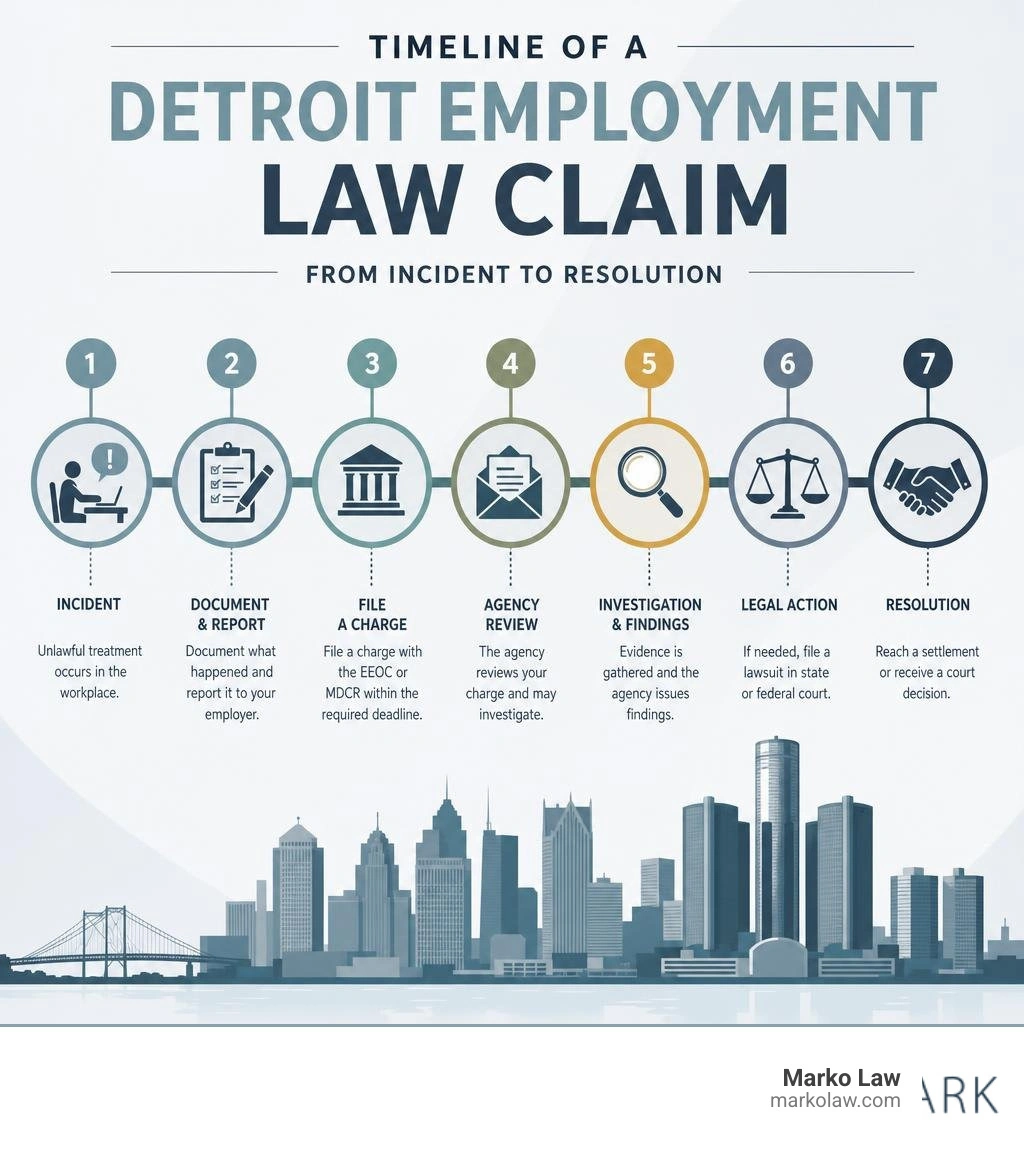
If you believe your rights have been violated, the steps you take in the immediate aftermath can make or break your case. Here is a practical roadmap to protecting yourself.
The moment you suspect something is wrong, start keeping a detailed log. Write down dates, times, locations, and exactly what was said or done. Keep this log on your personal phone or notebook—never on a work computer or work email account.
Collect copies of performance reviews, emails, text messages, and your employee handbook. However, be careful not to violate company policies or confidentiality agreements regarding proprietary business data when gathering your records.
While many employee handbooks state that you must report issues to HR immediately, it is highly beneficial to speak with an employment lawyer first. HR is there to protect the company, not you. A lawyer can help you draft your internal complaint in a way that clearly establishes your protected status and sets a legal paper trail. If you are wondering how to handle this initial stage, read our FAQ on What Should I Do If I Experience Workplace Discrimination?.
Not every unfair situation is a lawsuit, but many are. If you want to know if your specific situation meets the legal criteria for a lawsuit, read our breakdown: Can I File a Discrimination Claim Against My Employer?.
For most discrimination and harassment claims, you cannot simply walk into court and file a lawsuit. You must first "exhaust your administrative remedies" by filing a formal charge with a government agency.
In Detroit, you have two primary options: the federal Equal Employment Opportunity Commission (EEOC) and the Michigan Department of Civil Rights (MDCR).
Once you file, the agency may investigate, offer mediation, or attempt to settle the dispute. If the agency cannot resolve the issue or decides not to pursue it, they will issue you a Right-to-Sue Letter. This letter is your golden ticket—it gives you a limited window (usually 90 days from receipt) to file a formal lawsuit in court.
Not all employment claims are about discrimination; many are purely contractual.
Failing to follow these steps can derail your case before it even starts. In the classic case Baker v. City of Detroit, a city employee challenged a mandatory maternity leave policy. The court had to untangle whether the plaintiff had properly exhausted her union grievance remedies before bringing her claim to court, demonstrating how procedural contract rules can obscure and delay major civil rights issues if not handled precisely.
When you file an employment law claim, you are seeking to be "made whole"—essentially, to be put in the financial position you would have been in had the illegal behavior never occurred.
Depending on the nature of your claim, several types of damages may be available to you:
Many workers hesitate to contact a lawyer because they worry about the cost. After all, if you have just lost your job, the last thing you have is spare cash to pay an attorney by the hour.
That is why we handle employment law cases on a contingent fee basis.
Navigating the legal landscape can be confusing. Here are answers to some of the most common questions we hear from Detroit workers.
No. Both federal law (OSHA) and state law (MIOSHA) strictly prohibit employers from retaliating against workers who report safety hazards. If you are fired or demoted for pointing out dangerous conditions, you have grounds for a whistleblower retaliation claim. You can read more about these protections here: Can an Employee Be Fired for Reporting Unsafe Conditions at Work?.
Retaliation is not always a sudden firing. It often starts subtly. Common signs include:
To learn more about identifying these red flags, read our FAQs on What Are the Signs of Retaliation After Reporting Discrimination at Work in Michigan? and Can I Be Retaliated Against for Reporting Sexual Harassment in the Workplace?.
It depends entirely on the law that was violated:
When your livelihood is on the line, you cannot afford to take chances. Employers have HR departments, compliance officers, and high-priced defense attorneys whose sole job is to minimize their liability. You deserve to have an aggressive, experienced legal team in your corner to level the playing field.
At Marko Law, we have spent years standing up for workers in Detroit, Mount Pleasant, and across Michigan. We have built a reputation for relentless advocacy, recovering over $1 billion in verdicts and settlements for our clients—including a record-breaking $307.6 million civil rights verdict and an $11.67 million employment retaliation verdict.
We understand the tactics employers use to sweep discrimination under the rug, and we know how to hold them accountable. If you have been treated unfairly, discriminated against, or wrongfully terminated, let us help you fight for the justice and compensation you deserve. To understand what employers face when they cross these lines, read our article on What Are the Consequences for Employers Who Engage in Workplace Discrimination?.
If you are ready to take action, visit our Detroit Employment Law page to learn more about our local services, or contact us today for a free, confidential consultation.
Protect your rights with Marko Law — schedule your free case review today.
We Will Help You!
Get in touch with a real person 24/7/365.
If you’re a law firm owner and want help optimizing your practice for success, please email jon@markolaw.com

Real stories. Real results. From personal injury recoveries to civil rights victories, our clients trust Marko Law to deliver justice when it matters most. Hear what people across Michigan are saying about their experience with our legal team.

Big shoutout to the Marko Law squad. Gasper was an absolute assassin in the best possible way, and trust me, that's a high compliment coming from me. John Eads and Gasper tag-teamed those negotiations like champs. I'll be sending clients your way for the foreseeable future.
Alex Kay is absolutely a hell of a lawyer! He is compassionate and very thorough at his job! This process was a absolute breeze 🙌
I've been working with attorney Michael Jones for two years and couldn't have asked for a more dedicated attorney. He has never given up on my case and continues to fight hard to make sure justice is served. I highly recommend him to anyone who needs a lawyer who will stand by you.
Michael Jones and his team have been nothing but kind, courteous and very knowledgeable on any question I have had. They always answer my questions and walk me through the process. I would recommend Marko Law and Michael to anyone who needs an outstanding law firm.
From intake through the entire process, Michael Jones and his team have been doing an excellent job representing me. Their timely responses have given me true faith in their ability. I truly feel I could not be better represented anywhere else. Thank you, Michael and Dae!
Marko’s law firm truly has a great team ! Kyla in medical records is very comforting and pays great attention to detail!
I wanted to offer some positive feedback regarding Melody, who answers the phone. I found her to be very polite, cheerful and empathetic. She went above and beyond to make sure I could talk directly to the person who could best help me, and my issue was successfully resolved.
Marko Law is excellent! My case was handled very well. I appreciate the time Alex Kay spent to ensure I received the maximum payout, and his paralegal Tracey was great too. I recommend Alex Kay and Marko Law to everyone who needs a tried and trusted law firm!
Working with Marko Law Firm has been a superb experience! Alex Kay has done a phenomenal job handling my case, and his expertise has made a stressful situation feel much less daunting. He's been nothing but attentive and informative throughout the process.
Ariel Kellersohn is the best in the business. If you want a lawyer who dedicates herself to your case, you have found the right place. She upholds the highest standards of professionalism and is also very personable and easy to talk to. 10/10, if I could leave more than 5 stars I would!
Having Marko Law handle my case was the best decision I made. Alex Kay was excellent; he understood what I have been through and fought for me every step of the way. His dedication guided my case to a successful settlement. I would recommend them for any legal support you need.
What a fantastic experience I had working with the firm. You made me feel like you cared about me and not about making money. The communication was amazing, and you kept me informed on all aspects of my case. I would 100% recommend you and your firm.
They fight for the little guy. The process is generally hard, very hard, and mentally exhausting, but Marko and his phenomenal attorney Cait bring a lot of ease in that process. And WIN! Cait is straight up, honest of the risks and potential outcomes and such and fighter.
Great hard working firm that fights hard for their clients. Jon and his team are knowledgeable, dedicated and great people all around. Their results speak for themselves! Hire Marko!
John Marko handled my son's case wonderfully. He worked for us for 6 years to get my son the best settlement outcome. I highly recommend Marko Law.
I've been working here for three years and I can honestly say Jon Marko is a very passionate attorney with whom I'd trust a case with. He is honest, hard working and one of the smartest men I know. Wish I could give more than five stars!
Ernst and Marko is a firm that fights for the people. I have known Jon Marko for ten years and worked with him in civil litigation and an excessive force case. He is an aggressive and tireless advocate who fights for his clients to get them justice.
Marko Law exemplifies professionalism and diligence even in the most laborious cases. You truly feel protected and secure when handing Marko Law your vulnerability. They will always fight to protect your rights.
He was my attorney and couldn't of asked for a more aggressive and down to earth eager ATTORNEY! If you want a lawyer that will WIN then Jon Marko is the Man to call! I highly recommend him and we spoke whenever needed! Thank you again MARKO u were awesome:)
Thank you Jonathan Marko! You took my case and never let me down from day one! I recommend Marko Law; you will not regret it! Jonathan Marko is the most amazing Lawyer ever! The law firm is honest, fair, consistent, hard working and very nice! Thank you again!
Attorney Jon Marko is one of the finest attorneys I have ever had the opportunity to work with. His experience and calm courtroom demeanor leaves him unmatched, and makes him a truly aggressive advocate for his clients.
Marko Law is a breath of fresh air. They're responsive, they care and they get the job done. They have great communication which means you never feel out of the loop. Most of all they work hard until they get the outcome necessary. Love Marko and his team!
The Ernst and Marko Law firm has an amazing group of attorneys and staff that will make sure they give each and every client the personalized legal advice they need! They will fight for their clients to make justice is served! I highly recommend this firm!
I've know Jon Marko for years and he is simply the best. He has helped friends and family through tough times and I would trust him with any legal issue, considering that everyone I know that has hired him has had extremely favorable outcomes.
Jon Marko represented me in a lawsuit. He is extremely smart, hardworking, and dedicated to his clients. I'm an attorney myself so I understand what is required of an exceptional attorney. You will not be disappointed if you hire him and his firm to represent you!
The world needs more protectors like Jon Marko from police brutality. He was kind, generous, and reassuring when I spoke to him. Thank you for being a defender of the every man because it's the right thing to do.
Big shoutout to the Marko Law squad. Gasper was an absolute assassin in the best possible way, and trust me, that's a high compliment coming from me. John Eads and Gasper tag-teamed those negotiations like champs. I'll be sending clients your way for the foreseeable future.
Alex Kay is absolutely a hell of a lawyer! He is compassionate and very thorough at his job! This process was a absolute breeze 🙌
I've been working with attorney Michael Jones for two years and couldn't have asked for a more dedicated attorney. He has never given up on my case and continues to fight hard to make sure justice is served. I highly recommend him to anyone who needs a lawyer who will stand by you.
Michael Jones and his team have been nothing but kind, courteous and very knowledgeable on any question I have had. They always answer my questions and walk me through the process. I would recommend Marko Law and Michael to anyone who needs an outstanding law firm.
From intake through the entire process, Michael Jones and his team have been doing an excellent job representing me. Their timely responses have given me true faith in their ability. I truly feel I could not be better represented anywhere else. Thank you, Michael and Dae!
Marko’s law firm truly has a great team ! Kyla in medical records is very comforting and pays great attention to detail!
I wanted to offer some positive feedback regarding Melody, who answers the phone. I found her to be very polite, cheerful and empathetic. She went above and beyond to make sure I could talk directly to the person who could best help me, and my issue was successfully resolved.
Marko Law is excellent! My case was handled very well. I appreciate the time Alex Kay spent to ensure I received the maximum payout, and his paralegal Tracey was great too. I recommend Alex Kay and Marko Law to everyone who needs a tried and trusted law firm!
Working with Marko Law Firm has been a superb experience! Alex Kay has done a phenomenal job handling my case, and his expertise has made a stressful situation feel much less daunting. He's been nothing but attentive and informative throughout the process.
Ariel Kellersohn is the best in the business. If you want a lawyer who dedicates herself to your case, you have found the right place. She upholds the highest standards of professionalism and is also very personable and easy to talk to. 10/10, if I could leave more than 5 stars I would!
Having Marko Law handle my case was the best decision I made. Alex Kay was excellent; he understood what I have been through and fought for me every step of the way. His dedication guided my case to a successful settlement. I would recommend them for any legal support you need.
What a fantastic experience I had working with the firm. You made me feel like you cared about me and not about making money. The communication was amazing, and you kept me informed on all aspects of my case. I would 100% recommend you and your firm.
They fight for the little guy. The process is generally hard, very hard, and mentally exhausting, but Marko and his phenomenal attorney Cait bring a lot of ease in that process. And WIN! Cait is straight up, honest of the risks and potential outcomes and such and fighter.
Great hard working firm that fights hard for their clients. Jon and his team are knowledgeable, dedicated and great people all around. Their results speak for themselves! Hire Marko!
John Marko handled my son's case wonderfully. He worked for us for 6 years to get my son the best settlement outcome. I highly recommend Marko Law.
I've been working here for three years and I can honestly say Jon Marko is a very passionate attorney with whom I'd trust a case with. He is honest, hard working and one of the smartest men I know. Wish I could give more than five stars!
Ernst and Marko is a firm that fights for the people. I have known Jon Marko for ten years and worked with him in civil litigation and an excessive force case. He is an aggressive and tireless advocate who fights for his clients to get them justice.
Marko Law exemplifies professionalism and diligence even in the most laborious cases. You truly feel protected and secure when handing Marko Law your vulnerability. They will always fight to protect your rights.
He was my attorney and couldn't of asked for a more aggressive and down to earth eager ATTORNEY! If you want a lawyer that will WIN then Jon Marko is the Man to call! I highly recommend him and we spoke whenever needed! Thank you again MARKO u were awesome:)
Thank you Jonathan Marko! You took my case and never let me down from day one! I recommend Marko Law; you will not regret it! Jonathan Marko is the most amazing Lawyer ever! The law firm is honest, fair, consistent, hard working and very nice! Thank you again!
Attorney Jon Marko is one of the finest attorneys I have ever had the opportunity to work with. His experience and calm courtroom demeanor leaves him unmatched, and makes him a truly aggressive advocate for his clients.
Marko Law is a breath of fresh air. They're responsive, they care and they get the job done. They have great communication which means you never feel out of the loop. Most of all they work hard until they get the outcome necessary. Love Marko and his team!
The Ernst and Marko Law firm has an amazing group of attorneys and staff that will make sure they give each and every client the personalized legal advice they need! They will fight for their clients to make justice is served! I highly recommend this firm!
I've know Jon Marko for years and he is simply the best. He has helped friends and family through tough times and I would trust him with any legal issue, considering that everyone I know that has hired him has had extremely favorable outcomes.
Jon Marko represented me in a lawsuit. He is extremely smart, hardworking, and dedicated to his clients. I'm an attorney myself so I understand what is required of an exceptional attorney. You will not be disappointed if you hire him and his firm to represent you!
The world needs more protectors like Jon Marko from police brutality. He was kind, generous, and reassuring when I spoke to him. Thank you for being a defender of the every man because it's the right thing to do.
At Marko Law, we don’t just take cases. we take a stand. Whether you're facing an injury, injustice, or outright negligence, our team fights like it’s personal, because to you, it is.
Ready to make your voice heard?
We’re not here to play games. We’re here to win.