August 7, 2026
Salary vs Hourly: A Quick Start Guide to Comparing Pay Types
Salary vs Hourly: A Quick Start Guide to Comparing Pay Types - Learn about salary vs hourly

Salary vs Hourly: A Quick Start Guide to Comparing Pay Types - Learn about salary vs hourly

If you are feeling overwhelmed by unpaid bills or suspect your boss is taking advantage of your hard work, understanding salary vs hourly pay is the first step to standing up for your rights. The way you are paid does not just change how your paycheck looks. It dictates your legal rights, your work-life balance, and whether your employer is legally allowed to make you work for free.
Here is the quick breakdown to help you understand where you stand:
| Feature | Salary Pay | Hourly Pay |
|---|---|---|
| How It Is Calculated | Fixed annual amount divided evenly across pay periods. | A set rate paid for every single hour you actually work. |
| Overtime Eligibility | Often exempt (no overtime) if you meet specific duty and salary tests. | Guaranteed 1.5x pay for any hours worked over 40 in a workweek. |
| Pay Predictability | High. You get the same pay even if you work fewer hours. | Variable. Your pay fluctuates based on your scheduled hours. |
| Time Tracking | Usually focused on finishing tasks rather than clocking hours. | Strict requirement to log every minute of your shift. |
At Marko Law, we see hard-working Michigan employees struggle with these rules every day. Far too many employers in Detroit use confusing payroll labels to hide wage theft. They might call you a "salaried manager" just to force you into working 60 hours a week without paying you a single cent of overtime.
That is not just unfair. It is often a direct violation of the law.
Whether you are looking at a new job offer or trying to figure out if your current boss is cheating you out of your hard-earned money, you need to know the rules of the game. Let's look at how these pay structures work, what the law says, and how to tell if you are being misclassified.
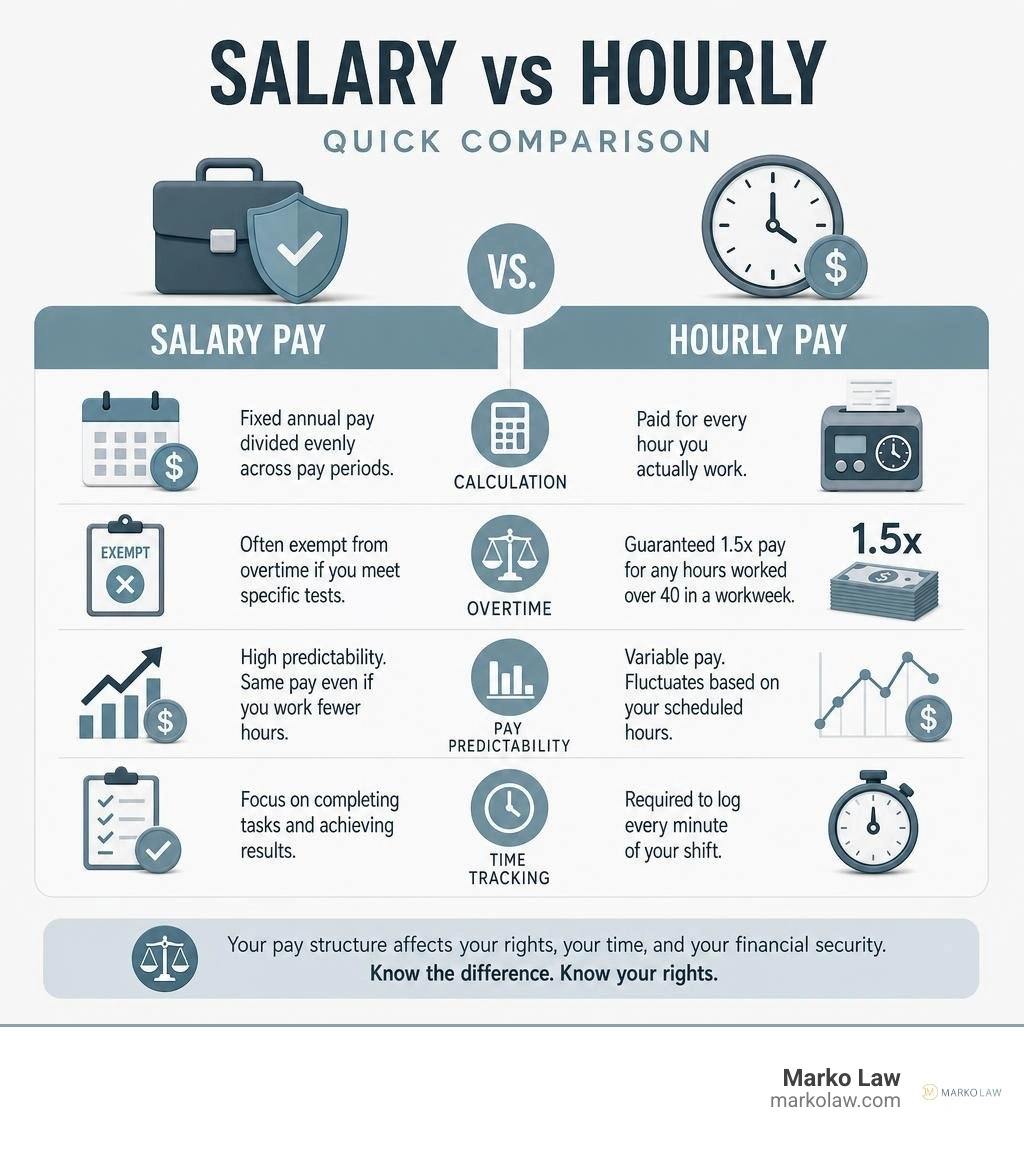
At its core, the difference between salary vs hourly compensation models comes down to how your labor is measured and valued.
For salaried employees, compensation is based on output and responsibility. When you accept a salaried role, you agree to perform a specific job function in exchange for a fixed annual sum. This annual salary is divided equally among your paychecks—whether you are paid weekly, bi-weekly, semi-monthly, or monthly. If a project takes 35 hours one week, you receive your full paycheck. If it takes 55 hours the next week, your pay remains exactly the same. Time tracking is rarely the main focus; instead, the emphasis is on meeting your professional goals.
For hourly employees, compensation is tied directly to the clock. You are paid a set hourly rate for every single minute you are on duty. If you work 40 hours, you get paid for 40 hours. If you work 41 hours, those extra minutes must be tracked and compensated. Because of this direct link between time and money, hourly workers are subject to strict time tracking. You must clock in and out for shifts, breaks, and lunches.
This structural difference affects your daily life. An hourly retail worker in Grand Rapids or a machinist in Flint knows that every minute of overtime translates to extra cash. Meanwhile, a salaried office worker in Southfield or Warren might find themselves answering late-night client emails for no additional compensation, effectively lowering their hourly worth.
Many people believe that if they receive a salary, they are automatically ineligible for overtime. This is one of the most common and expensive myths in the American workplace.
Overtime eligibility is not determined by whether you wear a suit, work at a desk, or receive a salary. It is strictly regulated by federal law under the Fair Labor Standards Act (FLSA). To understand your rights, you must first answer: What is the Fair Labor Standards Act (FLSA)?
The FLSA divides employees into two primary groups:
According to the Fair Labor Standards Act guidelines, an employer cannot simply choose to label you "exempt" to save on labor costs. To legally classify you as exempt, your job must pass three strict tests:
If your job does not meet all three of these requirements, you are a non-exempt employee. This means that even if you are paid on a salary basis, you are still legally entitled to overtime compensation.
Choosing between a salaried position and an hourly role is not just a matter of preference. It has a massive impact on your daily lifestyle, mental health, and long-term financial security. Let's weigh the pros and cons of each from both sides of the desk.
For workers, the choice between salary and hourly often comes down to a trade-off between predictability and direct compensation for your time.
Salaried Pros:
Salaried Cons:
Hourly Pros:
Hourly Cons:
To dive deeper into how these trade-offs play out in the modern job market, you can read this comprehensive Salary vs Hourly 2026 Guide.
For business owners in Michigan—from manufacturing facilities in Grand Rapids to retail shops in Royal Oak—the choice of pay structure is a balancing act between financial predictability and operational flexibility.
Overtime laws exist to protect workers from exploitation. Under both federal law and Michigan state law, the standard workweek is 40 hours. If a non-exempt employee works more than 40 hours in a single seven-day workweek, they must be paid an overtime rate of at least 1.5 times their regular hourly rate (often called "time-and-a-half").
To understand the exact rules governing your paycheck, it is helpful to look at the details: What are the minimum wage and overtime requirements under the FLSA?
One of the most common tactics used by dishonest employers is trying to bypass these rules entirely. A supervisor might tell you that because you are paid a salary, you do not qualify for overtime. Or, they might try to force you into a salaried agreement to avoid paying you for extra hours.
You should know that this is highly illegal. If you are wondering about this specific scenario, read more here: Can an employer force an hourly employee to be a salaried employee in order to not pay overtime?
Furthermore, some employees are classified as salaried non-exempt. This means they receive a steady, weekly salary as a baseline, but because they do not meet the legal duties test or earn below the $58,656 threshold, their employer is still legally required to track their hours and pay them 1.5 times their effective hourly rate for any hours worked over 40.
If you are currently salaried and working long hours, you might be earning far less than you think. To find out if your salary is actually a good deal, you need to calculate your effective hourly rate.
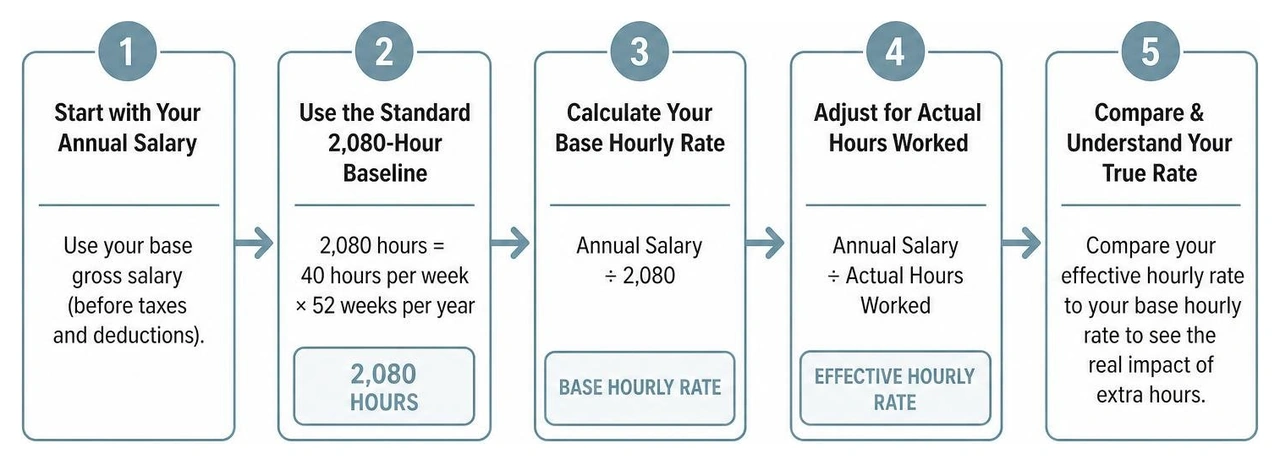
To calculate this, we look at the standard 2,080-hour baseline (which represents a standard 40-hour workweek multiplied by 52 weeks in a year).
Let's look at two different scenarios to see how working unpaid hours can quietly destroy your earning power:
Imagine you earn a $60,000 annual salary and work a standard 40-hour workweek.
Now, let's say you earn that same $60,000 annual salary, but your employer expects you to work 50 hours per week to keep up with your workload. Because you are classified as exempt, you do not receive any overtime pay.
By working those 10 "unpaid" hours every week, you have effectively taken a 20% pay cut. You are giving your employer 520 hours of free labor every year. If you were an hourly worker earning $28.85/hour with guaranteed overtime, those 50-hour workweeks would bring your annual earnings up to $74,144!
Employee misclassification is a serious form of wage theft. It occurs when an employer incorrectly labels a non-exempt worker as "exempt" (or misclassifies an employee as an independent contractor) to avoid paying overtime, providing benefits, or paying payroll taxes.
In Michigan, this is a massive problem. From construction sites in Macomb County to medical offices in Troy, workers are regularly cheated out of their overtime pay.
To protect yourself, you must learn to recognize the red flags: What are some common wage and hour violations employers may commit?
The legal penalties for employers who misclassify workers are severe. If you win a wage and hour lawsuit, your employer does not just have to pay you the money they stole. You are often entitled to significant legal remedies.
To find out what you could recover, see: What damages can I recover in a wage and hour lawsuit?
Under federal and Michigan law, courts can order employers to pay:
If you are looking for a new job or negotiating a promotion, how do you decide which pay structure is best for you? Use this simple decision framework to evaluate your options:
Yes! If a salaried employee earns less than the federal threshold of $58,656 per year ($1,128/week), or if their daily job duties do not meet the strict legal definitions of executive, professional, or administrative work, they are classified as salaried non-exempt. Their employer must track their hours and pay them 1.5 times their effective hourly rate for any hours worked over 40 in a workweek.
Generally, yes. Under the FLSA's salary basis test, an exempt employee must receive their full salary for any week in which they perform any work, regardless of how many hours they log. While employers can deduct accrued PTO for absences, they cannot dock a salaried worker's base pay for partial-day absences, temporary business slowdowns, or jury duty.
While federal law does not require benefits based on pay labels, the Affordable Care Act (ACA) mandates that employers with 50 or more full-time employees must offer health insurance to anyone working 30 or more hours per week. However, salaried positions are historically much more likely to offer comprehensive benefits packages, including paid sick leave, parental leave, and retirement contributions, compared to hourly roles.
Understanding salary vs hourly rules is about more than just managing your monthly budget—it is about protecting your basic rights as a worker. If your employer has misclassified you, forced you to work off-the-clock, or denied you the overtime pay you have rightfully earned, you do not have to accept it.
At Marko Law, we have spent years fighting for workers across Michigan—including Detroit, Grand Rapids, Flint, Troy, Warren, and Wayne County. We specialize in employment and labor law services and have a proven track record of securing over $2 billion in client recoveries.
We offer completely free consultations, and we work on a contingency basis—meaning you pay absolutely nothing unless we win your case.
Do not let an employer take advantage of your hard work. Contact Marko Law today to schedule your free, confidential case evaluation and let us help you get the justice and compensation you deserve.
We Will Help You!
Get in touch with a real person 24/7/365.
If you’re a law firm owner and want help optimizing your practice for success, please email jon@markolaw.com

Real stories. Real results. From personal injury recoveries to civil rights victories, our clients trust Marko Law to deliver justice when it matters most. Hear what people across Michigan are saying about their experience with our legal team.

Big shoutout to the Marko Law squad. Gasper was an absolute assassin in the best possible way, and trust me, that's a high compliment coming from me. John Eads and Gasper tag-teamed those negotiations like champs. I'll be sending clients your way for the foreseeable future.
Alex Kay is absolutely a hell of a lawyer! He is compassionate and very thorough at his job! This process was a absolute breeze 🙌
I've been working with attorney Michael Jones for two years and couldn't have asked for a more dedicated attorney. He has never given up on my case and continues to fight hard to make sure justice is served. I highly recommend him to anyone who needs a lawyer who will stand by you.
Michael Jones and his team have been nothing but kind, courteous and very knowledgeable on any question I have had. They always answer my questions and walk me through the process. I would recommend Marko Law and Michael to anyone who needs an outstanding law firm.
From intake through the entire process, Michael Jones and his team have been doing an excellent job representing me. Their timely responses have given me true faith in their ability. I truly feel I could not be better represented anywhere else. Thank you, Michael and Dae!
Marko’s law firm truly has a great team ! Kyla in medical records is very comforting and pays great attention to detail!
I wanted to offer some positive feedback regarding Melody, who answers the phone. I found her to be very polite, cheerful and empathetic. She went above and beyond to make sure I could talk directly to the person who could best help me, and my issue was successfully resolved.
Marko Law is excellent! My case was handled very well. I appreciate the time Alex Kay spent to ensure I received the maximum payout, and his paralegal Tracey was great too. I recommend Alex Kay and Marko Law to everyone who needs a tried and trusted law firm!
Working with Marko Law Firm has been a superb experience! Alex Kay has done a phenomenal job handling my case, and his expertise has made a stressful situation feel much less daunting. He's been nothing but attentive and informative throughout the process.
Ariel Kellersohn is the best in the business. If you want a lawyer who dedicates herself to your case, you have found the right place. She upholds the highest standards of professionalism and is also very personable and easy to talk to. 10/10, if I could leave more than 5 stars I would!
Having Marko Law handle my case was the best decision I made. Alex Kay was excellent; he understood what I have been through and fought for me every step of the way. His dedication guided my case to a successful settlement. I would recommend them for any legal support you need.
What a fantastic experience I had working with the firm. You made me feel like you cared about me and not about making money. The communication was amazing, and you kept me informed on all aspects of my case. I would 100% recommend you and your firm.
They fight for the little guy. The process is generally hard, very hard, and mentally exhausting, but Marko and his phenomenal attorney Cait bring a lot of ease in that process. And WIN! Cait is straight up, honest of the risks and potential outcomes and such and fighter.
Great hard working firm that fights hard for their clients. Jon and his team are knowledgeable, dedicated and great people all around. Their results speak for themselves! Hire Marko!
John Marko handled my son's case wonderfully. He worked for us for 6 years to get my son the best settlement outcome. I highly recommend Marko Law.
I've been working here for three years and I can honestly say Jon Marko is a very passionate attorney with whom I'd trust a case with. He is honest, hard working and one of the smartest men I know. Wish I could give more than five stars!
Ernst and Marko is a firm that fights for the people. I have known Jon Marko for ten years and worked with him in civil litigation and an excessive force case. He is an aggressive and tireless advocate who fights for his clients to get them justice.
Marko Law exemplifies professionalism and diligence even in the most laborious cases. You truly feel protected and secure when handing Marko Law your vulnerability. They will always fight to protect your rights.
He was my attorney and couldn't of asked for a more aggressive and down to earth eager ATTORNEY! If you want a lawyer that will WIN then Jon Marko is the Man to call! I highly recommend him and we spoke whenever needed! Thank you again MARKO u were awesome:)
Thank you Jonathan Marko! You took my case and never let me down from day one! I recommend Marko Law; you will not regret it! Jonathan Marko is the most amazing Lawyer ever! The law firm is honest, fair, consistent, hard working and very nice! Thank you again!
Attorney Jon Marko is one of the finest attorneys I have ever had the opportunity to work with. His experience and calm courtroom demeanor leaves him unmatched, and makes him a truly aggressive advocate for his clients.
Marko Law is a breath of fresh air. They're responsive, they care and they get the job done. They have great communication which means you never feel out of the loop. Most of all they work hard until they get the outcome necessary. Love Marko and his team!
The Ernst and Marko Law firm has an amazing group of attorneys and staff that will make sure they give each and every client the personalized legal advice they need! They will fight for their clients to make justice is served! I highly recommend this firm!
I've know Jon Marko for years and he is simply the best. He has helped friends and family through tough times and I would trust him with any legal issue, considering that everyone I know that has hired him has had extremely favorable outcomes.
Jon Marko represented me in a lawsuit. He is extremely smart, hardworking, and dedicated to his clients. I'm an attorney myself so I understand what is required of an exceptional attorney. You will not be disappointed if you hire him and his firm to represent you!
The world needs more protectors like Jon Marko from police brutality. He was kind, generous, and reassuring when I spoke to him. Thank you for being a defender of the every man because it's the right thing to do.
Big shoutout to the Marko Law squad. Gasper was an absolute assassin in the best possible way, and trust me, that's a high compliment coming from me. John Eads and Gasper tag-teamed those negotiations like champs. I'll be sending clients your way for the foreseeable future.
Alex Kay is absolutely a hell of a lawyer! He is compassionate and very thorough at his job! This process was a absolute breeze 🙌
I've been working with attorney Michael Jones for two years and couldn't have asked for a more dedicated attorney. He has never given up on my case and continues to fight hard to make sure justice is served. I highly recommend him to anyone who needs a lawyer who will stand by you.
Michael Jones and his team have been nothing but kind, courteous and very knowledgeable on any question I have had. They always answer my questions and walk me through the process. I would recommend Marko Law and Michael to anyone who needs an outstanding law firm.
From intake through the entire process, Michael Jones and his team have been doing an excellent job representing me. Their timely responses have given me true faith in their ability. I truly feel I could not be better represented anywhere else. Thank you, Michael and Dae!
Marko’s law firm truly has a great team ! Kyla in medical records is very comforting and pays great attention to detail!
I wanted to offer some positive feedback regarding Melody, who answers the phone. I found her to be very polite, cheerful and empathetic. She went above and beyond to make sure I could talk directly to the person who could best help me, and my issue was successfully resolved.
Marko Law is excellent! My case was handled very well. I appreciate the time Alex Kay spent to ensure I received the maximum payout, and his paralegal Tracey was great too. I recommend Alex Kay and Marko Law to everyone who needs a tried and trusted law firm!
Working with Marko Law Firm has been a superb experience! Alex Kay has done a phenomenal job handling my case, and his expertise has made a stressful situation feel much less daunting. He's been nothing but attentive and informative throughout the process.
Ariel Kellersohn is the best in the business. If you want a lawyer who dedicates herself to your case, you have found the right place. She upholds the highest standards of professionalism and is also very personable and easy to talk to. 10/10, if I could leave more than 5 stars I would!
Having Marko Law handle my case was the best decision I made. Alex Kay was excellent; he understood what I have been through and fought for me every step of the way. His dedication guided my case to a successful settlement. I would recommend them for any legal support you need.
What a fantastic experience I had working with the firm. You made me feel like you cared about me and not about making money. The communication was amazing, and you kept me informed on all aspects of my case. I would 100% recommend you and your firm.
They fight for the little guy. The process is generally hard, very hard, and mentally exhausting, but Marko and his phenomenal attorney Cait bring a lot of ease in that process. And WIN! Cait is straight up, honest of the risks and potential outcomes and such and fighter.
Great hard working firm that fights hard for their clients. Jon and his team are knowledgeable, dedicated and great people all around. Their results speak for themselves! Hire Marko!
John Marko handled my son's case wonderfully. He worked for us for 6 years to get my son the best settlement outcome. I highly recommend Marko Law.
I've been working here for three years and I can honestly say Jon Marko is a very passionate attorney with whom I'd trust a case with. He is honest, hard working and one of the smartest men I know. Wish I could give more than five stars!
Ernst and Marko is a firm that fights for the people. I have known Jon Marko for ten years and worked with him in civil litigation and an excessive force case. He is an aggressive and tireless advocate who fights for his clients to get them justice.
Marko Law exemplifies professionalism and diligence even in the most laborious cases. You truly feel protected and secure when handing Marko Law your vulnerability. They will always fight to protect your rights.
He was my attorney and couldn't of asked for a more aggressive and down to earth eager ATTORNEY! If you want a lawyer that will WIN then Jon Marko is the Man to call! I highly recommend him and we spoke whenever needed! Thank you again MARKO u were awesome:)
Thank you Jonathan Marko! You took my case and never let me down from day one! I recommend Marko Law; you will not regret it! Jonathan Marko is the most amazing Lawyer ever! The law firm is honest, fair, consistent, hard working and very nice! Thank you again!
Attorney Jon Marko is one of the finest attorneys I have ever had the opportunity to work with. His experience and calm courtroom demeanor leaves him unmatched, and makes him a truly aggressive advocate for his clients.
Marko Law is a breath of fresh air. They're responsive, they care and they get the job done. They have great communication which means you never feel out of the loop. Most of all they work hard until they get the outcome necessary. Love Marko and his team!
The Ernst and Marko Law firm has an amazing group of attorneys and staff that will make sure they give each and every client the personalized legal advice they need! They will fight for their clients to make justice is served! I highly recommend this firm!
I've know Jon Marko for years and he is simply the best. He has helped friends and family through tough times and I would trust him with any legal issue, considering that everyone I know that has hired him has had extremely favorable outcomes.
Jon Marko represented me in a lawsuit. He is extremely smart, hardworking, and dedicated to his clients. I'm an attorney myself so I understand what is required of an exceptional attorney. You will not be disappointed if you hire him and his firm to represent you!
The world needs more protectors like Jon Marko from police brutality. He was kind, generous, and reassuring when I spoke to him. Thank you for being a defender of the every man because it's the right thing to do.
At Marko Law, we don’t just take cases. we take a stand. Whether you're facing an injury, injustice, or outright negligence, our team fights like it’s personal, because to you, it is.
Ready to make your voice heard?
We’re not here to play games. We’re here to win.