August 5, 2026
All About Finding a Qualified Civil Rights Attorney
All About Finding a Qualified Civil Rights Attorney - Learn about civil rights attorney

All About Finding a Qualified Civil Rights Attorney - Learn about civil rights attorney
A civil rights attorney is a lawyer who fights for people whose constitutional rights have been violated — by police, employers, government agencies, or other institutions holding power over their lives.
If you're here, something happened to you. Maybe you were roughed up during an arrest. Maybe you were passed over for a promotion because of your race. Maybe you watched a loved one get hurt — or killed — by someone who was supposed to protect them. Whatever brought you to this page, you're not just looking for legal definitions. You're looking for answers. And you deserve them.
Here's a quick overview of what a civil rights attorney does and when you may need one:
| What They Handle | Examples |
|---|---|
| Police misconduct | Excessive force, false arrest, wrongful death |
| Employment discrimination | Race, gender, disability, retaliation |
| Institutional abuse | Prisons, schools, foster care |
| Housing discrimination | Denial of housing based on protected class |
| Voting rights violations | Suppression, intimidation, access barriers |
| Free speech & religion | Government retaliation for protected expression |
Civil rights law is rooted in the U.S. Constitution and federal statutes like 42 U.S.C. § 1983 and the Civil Rights Act of 1964. These laws exist to protect you from abuse by those in power. But knowing your rights and enforcing them are two very different things.
The gap between those two things? That's where a civil rights attorney comes in.
No one beats the system alone. Successful civil rights litigation requires strategy, experience, and a lawyer willing to go all the way to trial if that's what justice demands.
This guide will walk you through everything you need to know — from the laws that protect you, to how courts work, to how to find the right attorney for your specific situation in Michigan.
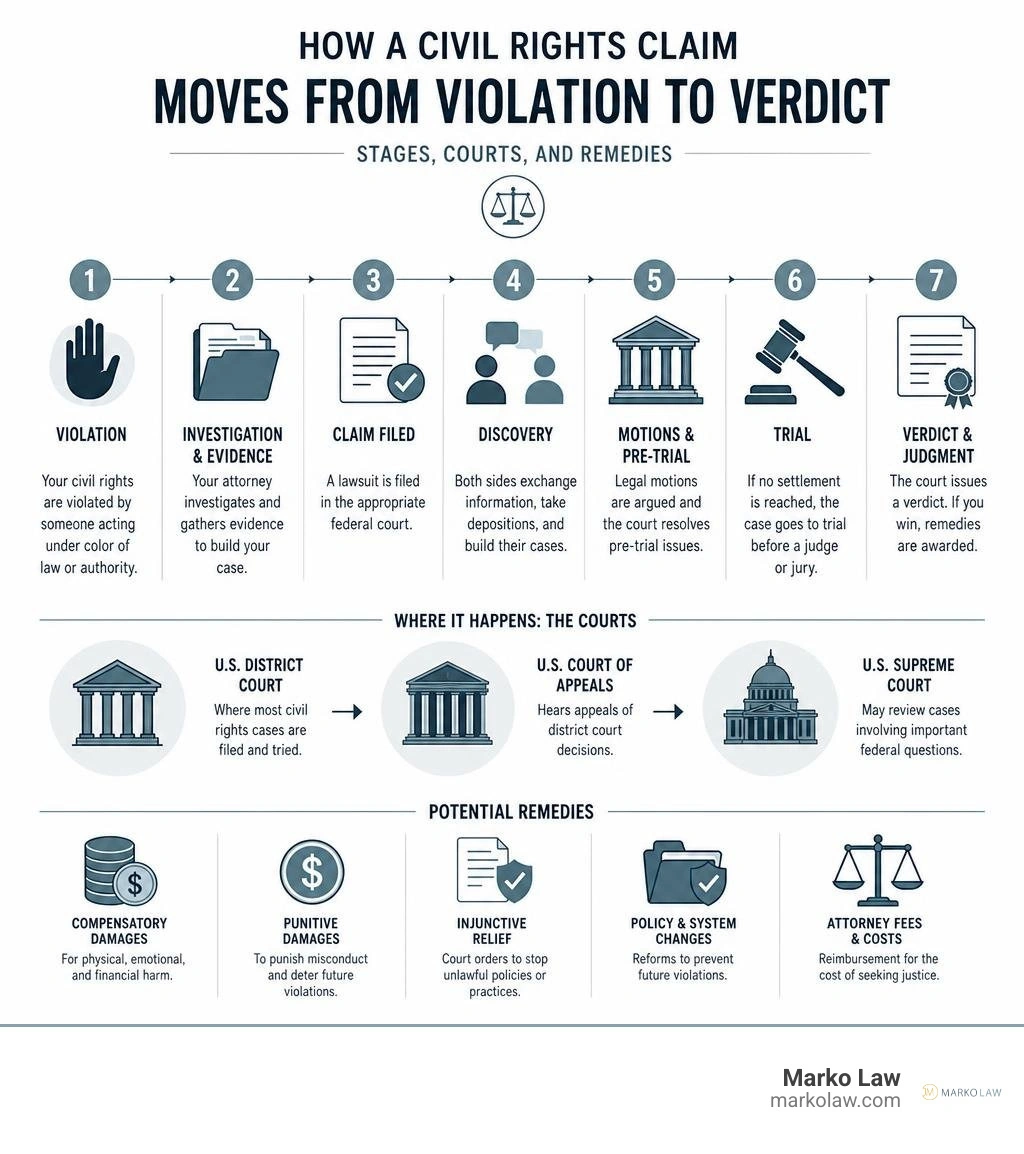
At its core, a civil rights attorney is an advocate for the marginalized, a defender of personal liberties, and a legal shield against government overreach. When a state actor, a police officer, a public school system, or a corporate employer steps over the legal line, these specialized attorneys step in to hold them accountable.
To understand their role, we first have to ask: What Are Civil Rights? Civil rights are the essential guarantees of equal social opportunities and equal protection under the law, regardless of race, religion, sex, age, national origin, or disability. Unlike civil liberties, which are broad freedoms guaranteed by the Bill of Rights (like freedom of speech), civil rights are focused on preventing discriminatory treatment and securing basic human dignity.
So, What Types of Cases Do Civil Rights Lawyers Handle? A qualified lawyer in this field must navigate a wide variety of disputes, including:
The history of civil rights law is defined by landmark courtroom battles. Today's advocates stand on the shoulders of giants like Fred Gray, whom Dr. Martin Luther King Jr. famously called the "chief counsel" of the Civil Rights Movement. Gray opened his Montgomery law office in 1954 as one of the few African American attorneys in Alabama. Over a historic 70-year career, he represented Rosa Parks, Claudette Colvin, and the Selma-to-Montgomery marchers, securing victories that paved the way for the Voting Rights Act of 1965. You can read more about his legacy through Fred Gray's historical achievements and how he was honored for his decades of service in this Alabama statue news coverage.
Modern advocacy continues this legacy through massive, high-profile civil rights settlements that force institutional change. Dedicated legal teams have secured historic relief for victims of systemic injustice, such as landmark multi-million dollar settlements for victims of police misconduct and massive compensation for communities suffering from environmental injustice, like the children of Flint, Michigan. These cases prove that civil rights litigation is not just about individual compensation; it is a vital mechanism for forcing structural reforms and holding the powerful accountable.
Winning a civil rights lawsuit requires linking the injustice you experienced to specific, powerful legal statutes. The legal framework used by a civil rights attorney relies on both constitutional amendments and federal civil rights legislation:
If you suspect your rights have been infringed, you might wonder: How Do I Know If My Civil Rights Have Been Violated? Generally, a violation occurs when a government official or an entity acting under "color of law" acts with deliberate indifference to your safety, targets you based on a protected characteristic, or uses excessive force that leads to injury or death.
To see how these federal laws translate into local battles, look no further than our own state's history. There are 8 Shocking Civil Rights Violations That Actually Happened in Michigan and Went to Court, showcasing everything from severe police misconduct to corporate exploitation.
One major battleground in civil rights law is systemic housing and lending discrimination. The Fair Housing Act of 1968 protects buyers and renters from discrimination. However, systemic violations continue in more sophisticated forms, such as reverse redlining — a predatory practice where financial institutions target minority communities for high-cost, deceptive, or unfair loans rather than denying them credit entirely. Leading fair housing advocates have spent decades pioneering litigation to challenge appraisal bias, exclusionary housing policies, and the denial of basic municipal services to minority neighborhoods. These efforts show that civil rights law must constantly evolve to dismantle systemic barriers.
When filing a civil rights lawsuit, one of the most critical strategic decisions your civil rights attorney will make is choosing whether to file in state or federal court. Both systems have unique rules, procedures, and advantages.
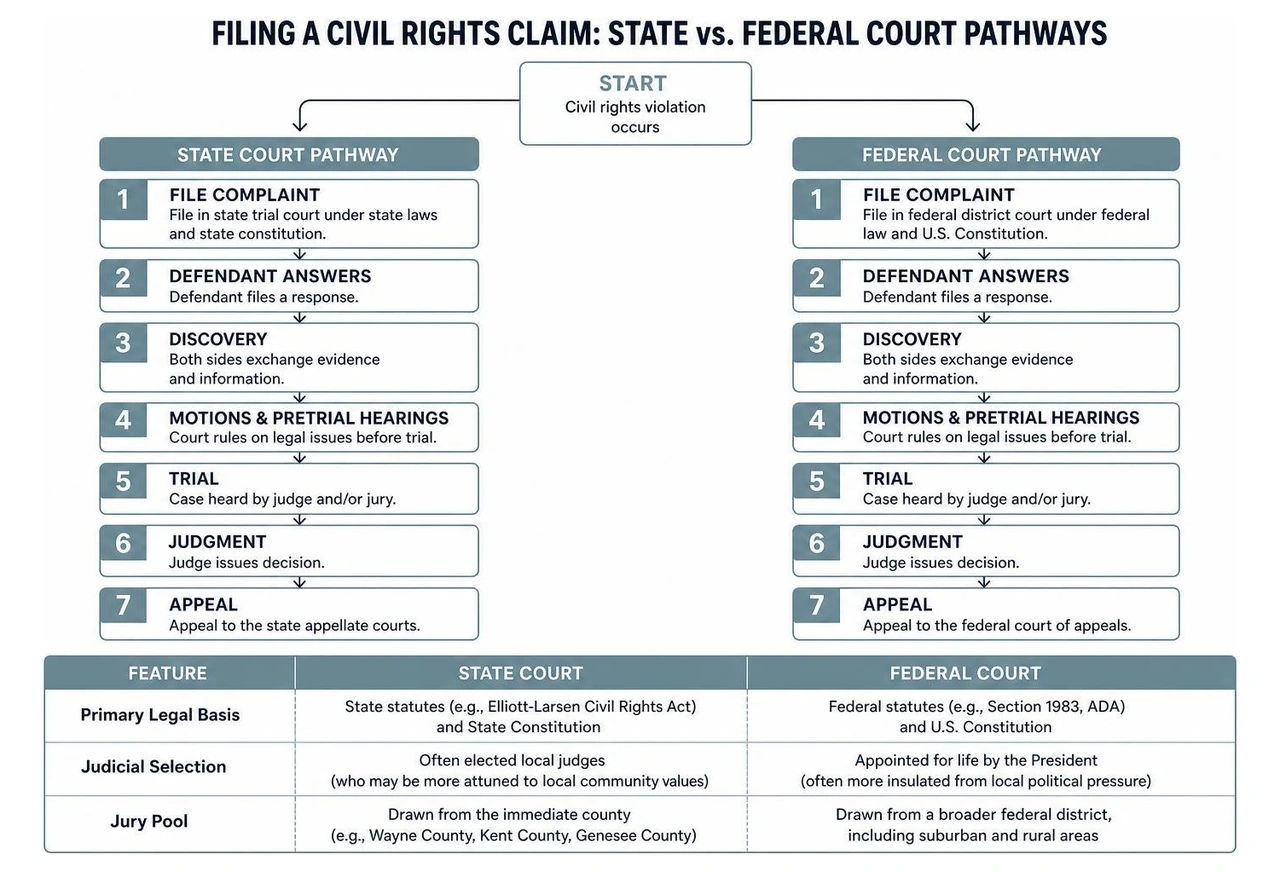
| Feature | State Court | Federal Court |
|---|---|---|
| Primary Legal Basis | State statutes (e.g., Elliott-Larsen Civil Rights Act) and State Constitution | Federal statutes (e.g., Section 1983, ADA) and U.S. Constitution |
| Judicial Selection | Often elected local judges (who may be more attuned to local community values) | Appointed for life by the President (often more insulated from local political pressure) |
| Jury Pool | Drawn from the immediate county (e.g., Wayne County, Kent County, Genesee County) | Drawn from a broader federal district, including suburban and rural areas |
| Speed of Litigation | Varies widely by local county docket speeds | Generally follows strict, scheduling orders |
| Key Remedies | Compensatory damages, injunctive relief, and specific state-law penalties | Compensatory damages, punitive damages, and statutory attorney's fees |
In Michigan, state court is often chosen when pursuing claims under the Elliott-Larsen Civil Rights Act (ELCRA), which provides robust protections against discrimination in employment, housing, public accommodations, and education. If you are dealing with Civil Rights Violations in Detroit Seeking Justice and Equality, state-level protections can be incredibly powerful. Our city has a long history of utilizing local and state courts to challenge institutional bias, a legacy that remains vibrant today. For a modern perspective, look at Detroit Pride Justice Strong A Look at How Our City Fights for Civil Rights in 2026.
Federal court, on the other hand, is the standard venue for Section 1983 claims involving police misconduct or federal constitutional violations. Federal courts are highly structured, and federal judges are deeply experienced in complex constitutional law. Depending on the nature of your case, your attorney may seek compensatory damages to cover your medical bills, lost wages, and emotional distress, or injunctive relief, which is a court order forcing the defendant to change their policies, implement training, or halt discriminatory practices.
Perhaps the single greatest obstacle in police misconduct and excessive force litigation is the judicial doctrine known as qualified immunity.
Qualified immunity is a legal shield that protects government officials, including police officers, from being held personally liable for constitutional violations unless their conduct violated "clearly established law." In practice, this means that even if a court agrees that an officer used excessive force, the case can be dismissed if there isn't a prior court ruling with nearly identical facts declaring that specific conduct illegal.
This makes hiring a specialized Civil Rights Lawyer for Police Excessive Force in Michigan absolutely essential. Overcoming this barrier requires deep knowledge of federal Section 1983 claims and the ability to find and present precise legal precedents to prove that the officer's actions violated clearly established standards.
To bypass qualified immunity and force real institutional change, civil rights attorneys often employ a strategy known as movement lawyering. This approach combines aggressive courtroom litigation with grassroots organizing, media engagement, and community activism. Movement lawyering recognizes that legal victories are most effective when backed by public pressure.
When systemic patterns of misconduct are uncovered within an institution — such as a police department, school district, or prison system — litigation can lead to consent decrees. A consent decree is a court-approved, legally binding agreement that mandates structural reforms, independent monitoring, and regular reporting to ensure the institution corrects its illegal practices. Whether addressing police brutality or institutional abuse in schools, these decrees are vital for securing long-term safety and accountability.
If your rights have been violated, finding the right civil rights attorney is the most important step you can take. This is a highly specialized field of law; you need someone with the experience, resources, and dedication to stand up to powerful government and corporate entities.
When researching attorneys in Michigan, here are key steps to take:
That civil rights litigation can be incredibly expensive. This is where pro bono services and legal aid organizations play a crucial role. National organizations, such as the Lawyers' Committee for Civil Rights Under Law, partner with private law firms to scale up major impact litigation. The Lawyers' Committee estimates that without pro bono assistance from private firms, its active docket would be limited to approximately twenty matters on any given day, compared to the usual eighty matters they are able to handle. These partnerships ensure that low-income victims of discrimination still have access to top-tier legal representation.
While legal aid and public interest organizations do incredible work, their resources are often stretched thin, and they must limit their cases to broad, systemic "impact" lawsuits. If you have suffered individual, catastrophic injuries, severe economic loss, or personal trauma due to a civil rights violation, hiring a private civil rights attorney is usually your best path to securing direct justice.
Most private civil rights lawyers operate on a contingency fee structure. This means you do not pay any upfront legal fees or out-of-pocket litigation expenses. The attorney only gets paid if they successfully secure a settlement or win a verdict on your behalf, taking a pre-agreed percentage of the recovery. This allows everyday individuals to stand on equal footing with wealthy corporations and government agencies.
When choosing a private attorney, look for a proven track record of trial experience. Some lawyers prefer to settle cases quickly to avoid the stress of court, but a fighter's mentality is essential. Your legal team should be prepared to take your case all the way to a jury if a fair settlement cannot be reached.
If you are considering filing a lawsuit, you likely have practical questions, such as: What Damages Can I Recover in a Civil Rights Lawsuit? Compensation can cover medical expenses, mental health treatment, lost wages, pain and suffering, and occasionally punitive damages designed to punish the wrongdoer. You might also wonder: How Long Does It Take to Reach a Settlement in a Civil Rights Case? While some cases settle during early negotiations or discovery, complex civil rights disputes can take anywhere from several months to several years to fully resolve.
To ensure you are hiring the best possible advocate for your case, prepare a list of targeted questions for your initial consultation:
Civil rights protections primarily guard against government intrusion and discrimination by state actors (such as police officers, public school administrators, or government agencies). Constitutional protections, like the Fourth Amendment or Section 1983, only apply to actions taken under "color of law."
Private conduct, such as discrimination by a private landlord, a private employer, or a local business, is not governed directly by the Constitution. Instead, discriminatory actions by private entities are handled under specific federal and state statutes, such as Title VII of the Civil Rights Act (for employment) or Michigan's Elliott-Larsen Civil Rights Act, which explicitly outlaw discrimination in the private sector based on protected characteristics.
Qualified immunity acts as a powerful legal shield that protects law enforcement officers from being held personally liable in civil lawsuits. To overcome qualified immunity, your attorney must prove two things: first, that the officer's conduct violated your constitutional rights, and second, that the right was "clearly established" at the time of the incident. This typically requires finding a prior binding court ruling with nearly identical facts. Because this standard is so high, qualified immunity often blocks police misconduct lawsuits from ever reaching a jury, making highly strategic, experienced legal representation absolutely critical.
Yes. Civil claims are entirely separate from the criminal justice system. The criminal system is designed to punish illegal behavior on behalf of the state, whereas the civil system is designed to compensate victims and secure personal justice.
Furthermore, the standard for the burden of proof is much lower in civil court. In a criminal case, prosecutors must prove guilt "beyond a reasonable doubt." In a civil rights lawsuit, you only need to prove your case by a "preponderance of the evidence" — meaning it is more likely than not that your rights were violated. Because of this, you can successfully pursue a civil rights claim even if the state never files criminal charges against the wrongdoer, or even if they are acquitted in a criminal trial.
When your constitutional rights are violated, the emotional, physical, and financial toll can be overwhelming. But you do not have to carry that burden alone. At Marko Law, we are dedicated to standing beside you, fighting the powerful, and securing the justice and compensation you deserve.
As a premier Detroit-based advocacy firm, we serve clients across Michigan — including Detroit, Grand Rapids, Flint, Troy, Canton, Westland, Taylor, Ypsilanti, Dearborn, Southfield, and throughout Wayne, Oakland, Macomb, Kent, and Genesee Counties. We bring the resources, trial experience, and relentless dedication needed to take on complex civil rights disputes, police misconduct cases, and systemic discrimination claims.
Our record speaks for itself, with over $2 billion in client recoveries. We offer completely free, confidential consultations, and we operate on a strict contingency fee basis- meaning you pay absolutely nothing unless we win your case.
If you are ready to stand up for your rights and hold those in power accountable, we are ready to fight for you. Protect Your Rights with Marko Law today by reaching out for your free consultation.
We Will Help You!
Get in touch with a real person 24/7/365.
If you’re a law firm owner and want help optimizing your practice for success, please email jon@markolaw.com

Real stories. Real results. From personal injury recoveries to civil rights victories, our clients trust Marko Law to deliver justice when it matters most. Hear what people across Michigan are saying about their experience with our legal team.

Big shoutout to the Marko Law squad. Gasper was an absolute assassin in the best possible way, and trust me, that's a high compliment coming from me. John Eads and Gasper tag-teamed those negotiations like champs. I'll be sending clients your way for the foreseeable future.
Alex Kay is absolutely a hell of a lawyer! He is compassionate and very thorough at his job! This process was a absolute breeze 🙌
I've been working with attorney Michael Jones for two years and couldn't have asked for a more dedicated attorney. He has never given up on my case and continues to fight hard to make sure justice is served. I highly recommend him to anyone who needs a lawyer who will stand by you.
Michael Jones and his team have been nothing but kind, courteous and very knowledgeable on any question I have had. They always answer my questions and walk me through the process. I would recommend Marko Law and Michael to anyone who needs an outstanding law firm.
From intake through the entire process, Michael Jones and his team have been doing an excellent job representing me. Their timely responses have given me true faith in their ability. I truly feel I could not be better represented anywhere else. Thank you, Michael and Dae!
Marko’s law firm truly has a great team ! Kyla in medical records is very comforting and pays great attention to detail!
I wanted to offer some positive feedback regarding Melody, who answers the phone. I found her to be very polite, cheerful and empathetic. She went above and beyond to make sure I could talk directly to the person who could best help me, and my issue was successfully resolved.
Marko Law is excellent! My case was handled very well. I appreciate the time Alex Kay spent to ensure I received the maximum payout, and his paralegal Tracey was great too. I recommend Alex Kay and Marko Law to everyone who needs a tried and trusted law firm!
Working with Marko Law Firm has been a superb experience! Alex Kay has done a phenomenal job handling my case, and his expertise has made a stressful situation feel much less daunting. He's been nothing but attentive and informative throughout the process.
Ariel Kellersohn is the best in the business. If you want a lawyer who dedicates herself to your case, you have found the right place. She upholds the highest standards of professionalism and is also very personable and easy to talk to. 10/10, if I could leave more than 5 stars I would!
Having Marko Law handle my case was the best decision I made. Alex Kay was excellent; he understood what I have been through and fought for me every step of the way. His dedication guided my case to a successful settlement. I would recommend them for any legal support you need.
What a fantastic experience I had working with the firm. You made me feel like you cared about me and not about making money. The communication was amazing, and you kept me informed on all aspects of my case. I would 100% recommend you and your firm.
They fight for the little guy. The process is generally hard, very hard, and mentally exhausting, but Marko and his phenomenal attorney Cait bring a lot of ease in that process. And WIN! Cait is straight up, honest of the risks and potential outcomes and such and fighter.
Great hard working firm that fights hard for their clients. Jon and his team are knowledgeable, dedicated and great people all around. Their results speak for themselves! Hire Marko!
John Marko handled my son's case wonderfully. He worked for us for 6 years to get my son the best settlement outcome. I highly recommend Marko Law.
I've been working here for three years and I can honestly say Jon Marko is a very passionate attorney with whom I'd trust a case with. He is honest, hard working and one of the smartest men I know. Wish I could give more than five stars!
Ernst and Marko is a firm that fights for the people. I have known Jon Marko for ten years and worked with him in civil litigation and an excessive force case. He is an aggressive and tireless advocate who fights for his clients to get them justice.
Marko Law exemplifies professionalism and diligence even in the most laborious cases. You truly feel protected and secure when handing Marko Law your vulnerability. They will always fight to protect your rights.
He was my attorney and couldn't of asked for a more aggressive and down to earth eager ATTORNEY! If you want a lawyer that will WIN then Jon Marko is the Man to call! I highly recommend him and we spoke whenever needed! Thank you again MARKO u were awesome:)
Thank you Jonathan Marko! You took my case and never let me down from day one! I recommend Marko Law; you will not regret it! Jonathan Marko is the most amazing Lawyer ever! The law firm is honest, fair, consistent, hard working and very nice! Thank you again!
Attorney Jon Marko is one of the finest attorneys I have ever had the opportunity to work with. His experience and calm courtroom demeanor leaves him unmatched, and makes him a truly aggressive advocate for his clients.
Marko Law is a breath of fresh air. They're responsive, they care and they get the job done. They have great communication which means you never feel out of the loop. Most of all they work hard until they get the outcome necessary. Love Marko and his team!
The Ernst and Marko Law firm has an amazing group of attorneys and staff that will make sure they give each and every client the personalized legal advice they need! They will fight for their clients to make justice is served! I highly recommend this firm!
I've know Jon Marko for years and he is simply the best. He has helped friends and family through tough times and I would trust him with any legal issue, considering that everyone I know that has hired him has had extremely favorable outcomes.
Jon Marko represented me in a lawsuit. He is extremely smart, hardworking, and dedicated to his clients. I'm an attorney myself so I understand what is required of an exceptional attorney. You will not be disappointed if you hire him and his firm to represent you!
The world needs more protectors like Jon Marko from police brutality. He was kind, generous, and reassuring when I spoke to him. Thank you for being a defender of the every man because it's the right thing to do.
Big shoutout to the Marko Law squad. Gasper was an absolute assassin in the best possible way, and trust me, that's a high compliment coming from me. John Eads and Gasper tag-teamed those negotiations like champs. I'll be sending clients your way for the foreseeable future.
Alex Kay is absolutely a hell of a lawyer! He is compassionate and very thorough at his job! This process was a absolute breeze 🙌
I've been working with attorney Michael Jones for two years and couldn't have asked for a more dedicated attorney. He has never given up on my case and continues to fight hard to make sure justice is served. I highly recommend him to anyone who needs a lawyer who will stand by you.
Michael Jones and his team have been nothing but kind, courteous and very knowledgeable on any question I have had. They always answer my questions and walk me through the process. I would recommend Marko Law and Michael to anyone who needs an outstanding law firm.
From intake through the entire process, Michael Jones and his team have been doing an excellent job representing me. Their timely responses have given me true faith in their ability. I truly feel I could not be better represented anywhere else. Thank you, Michael and Dae!
Marko’s law firm truly has a great team ! Kyla in medical records is very comforting and pays great attention to detail!
I wanted to offer some positive feedback regarding Melody, who answers the phone. I found her to be very polite, cheerful and empathetic. She went above and beyond to make sure I could talk directly to the person who could best help me, and my issue was successfully resolved.
Marko Law is excellent! My case was handled very well. I appreciate the time Alex Kay spent to ensure I received the maximum payout, and his paralegal Tracey was great too. I recommend Alex Kay and Marko Law to everyone who needs a tried and trusted law firm!
Working with Marko Law Firm has been a superb experience! Alex Kay has done a phenomenal job handling my case, and his expertise has made a stressful situation feel much less daunting. He's been nothing but attentive and informative throughout the process.
Ariel Kellersohn is the best in the business. If you want a lawyer who dedicates herself to your case, you have found the right place. She upholds the highest standards of professionalism and is also very personable and easy to talk to. 10/10, if I could leave more than 5 stars I would!
Having Marko Law handle my case was the best decision I made. Alex Kay was excellent; he understood what I have been through and fought for me every step of the way. His dedication guided my case to a successful settlement. I would recommend them for any legal support you need.
What a fantastic experience I had working with the firm. You made me feel like you cared about me and not about making money. The communication was amazing, and you kept me informed on all aspects of my case. I would 100% recommend you and your firm.
They fight for the little guy. The process is generally hard, very hard, and mentally exhausting, but Marko and his phenomenal attorney Cait bring a lot of ease in that process. And WIN! Cait is straight up, honest of the risks and potential outcomes and such and fighter.
Great hard working firm that fights hard for their clients. Jon and his team are knowledgeable, dedicated and great people all around. Their results speak for themselves! Hire Marko!
John Marko handled my son's case wonderfully. He worked for us for 6 years to get my son the best settlement outcome. I highly recommend Marko Law.
I've been working here for three years and I can honestly say Jon Marko is a very passionate attorney with whom I'd trust a case with. He is honest, hard working and one of the smartest men I know. Wish I could give more than five stars!
Ernst and Marko is a firm that fights for the people. I have known Jon Marko for ten years and worked with him in civil litigation and an excessive force case. He is an aggressive and tireless advocate who fights for his clients to get them justice.
Marko Law exemplifies professionalism and diligence even in the most laborious cases. You truly feel protected and secure when handing Marko Law your vulnerability. They will always fight to protect your rights.
He was my attorney and couldn't of asked for a more aggressive and down to earth eager ATTORNEY! If you want a lawyer that will WIN then Jon Marko is the Man to call! I highly recommend him and we spoke whenever needed! Thank you again MARKO u were awesome:)
Thank you Jonathan Marko! You took my case and never let me down from day one! I recommend Marko Law; you will not regret it! Jonathan Marko is the most amazing Lawyer ever! The law firm is honest, fair, consistent, hard working and very nice! Thank you again!
Attorney Jon Marko is one of the finest attorneys I have ever had the opportunity to work with. His experience and calm courtroom demeanor leaves him unmatched, and makes him a truly aggressive advocate for his clients.
Marko Law is a breath of fresh air. They're responsive, they care and they get the job done. They have great communication which means you never feel out of the loop. Most of all they work hard until they get the outcome necessary. Love Marko and his team!
The Ernst and Marko Law firm has an amazing group of attorneys and staff that will make sure they give each and every client the personalized legal advice they need! They will fight for their clients to make justice is served! I highly recommend this firm!
I've know Jon Marko for years and he is simply the best. He has helped friends and family through tough times and I would trust him with any legal issue, considering that everyone I know that has hired him has had extremely favorable outcomes.
Jon Marko represented me in a lawsuit. He is extremely smart, hardworking, and dedicated to his clients. I'm an attorney myself so I understand what is required of an exceptional attorney. You will not be disappointed if you hire him and his firm to represent you!
The world needs more protectors like Jon Marko from police brutality. He was kind, generous, and reassuring when I spoke to him. Thank you for being a defender of the every man because it's the right thing to do.
At Marko Law, we don’t just take cases. we take a stand. Whether you're facing an injury, injustice, or outright negligence, our team fights like it’s personal, because to you, it is.
Ready to make your voice heard?
We’re not here to play games. We’re here to win.