August 6, 2026
How to File a Civil Rights Lawsuit and Make Your Voice Heard
Learn how to file a civil rights lawsuit step-by-step and protect your rights with expert legal guidance.

Learn how to file a civil rights lawsuit step-by-step and protect your rights with expert legal guidance.
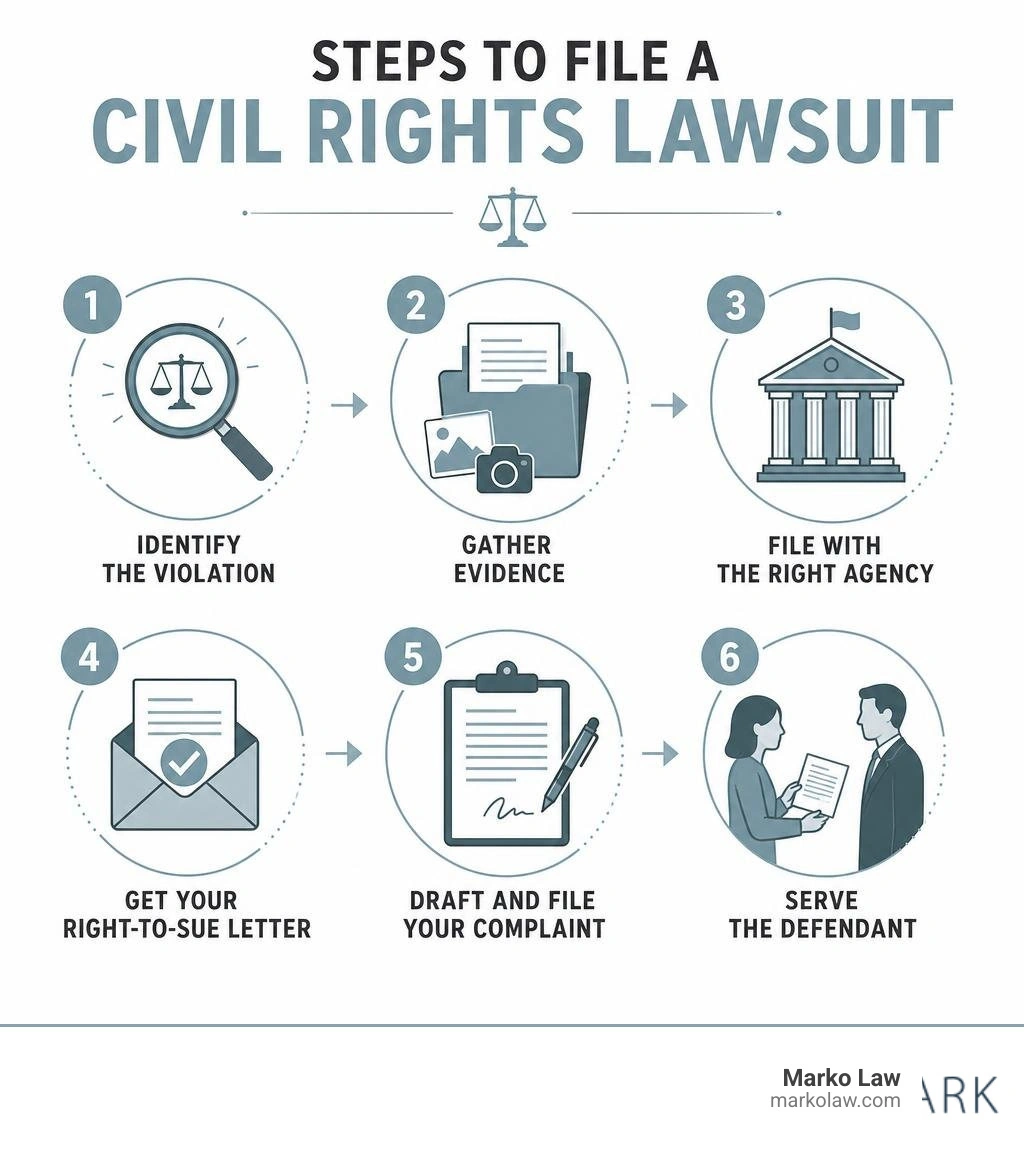
How to file a civil rights lawsuit comes down to six core steps:
Your rights were violated. Maybe it was a police officer who used excessive force. Maybe your employer fired you because of your race, gender, or disability. Maybe a government agency treated you differently because of who you are.
Whatever happened, you are probably feeling something right now — anger, confusion, maybe fear. You might be wondering if anyone will actually listen. Whether the system will work for you, not against you.
Here is the truth: the law gives you real tools to fight back. In 2024 alone, federal courts saw over 40,000 civil rights filings. Ordinary people — not just lawyers — used the legal system to hold powerful institutions accountable.
This guide walks you through exactly what you need to know, from identifying your violation to walking into court prepared.
Before we talk about courtrooms and legal forms, we need to answer a fundamental question: what exactly is a civil rights violation?
At its core, a civil right is a legally protected guarantee of equal treatment and personal freedom. These rights are secured by the U.S. Constitution and federal and state laws. When a person, business, or government entity discriminates against you based on a protected characteristic—such as race, color, national origin, religion, gender, age, or disability—they have crossed a legal line.
In our work across Detroit, Mount Pleasant, and Chicago, we see civil rights violations take many forms. Some of the most common include:
To help you figure out if what you experienced constitutes a legal violation, you can read our guide on How Do I Know If My Civil Rights Have Been Violated.
It is also important to understand the concept of "color of law." In many civil rights cases, particularly those involving law enforcement or government officials, the violator must have been acting under "color of law." This means they were using authority granted to them by a local, state, or federal government. If you believe a Detroit or Illinois official abused their government authority to violate your constitutional protections, a Civil Liberties Violations Attorney in Detroit can help you hold them accountable.
For a broader look at how the law defines these protections, you can review the Lawsuits for Civil Rights Violations and Discrimination FAQ - FindLaw .
If you are suing a state or local government official for violating your constitutional rights, your primary vehicle in federal court is 42 U.S.C. Section 1983.
Historically, Section 1983 was passed during the Reconstruction era to protect newly freed citizens from state-level abuses. Today, it remains the most powerful tool for civil rights enforcement. Over 30,000 Section 1983 cases are filed in federal courts every single year.
To succeed in a Section 1983 claim, you must prove two main elements:
To learn more about this specific law, take a look at our detailed breakdown on What Is Section 1983 of the U.S. Code and explore What Types of Violations Can Be Addressed Through a Section 1983 Claim.
If you are suing a police officer or other government employee under Section 1983, you will inevitably run into a major legal hurdle: qualified immunity.
Qualified immunity is a judicial doctrine that shields government officials from personal liability in civil lawsuits unless their conduct violates "clearly established" statutory or constitutional rights. In simple terms, it means you cannot just prove that the officer violated your rights; you must also prove that a reasonable officer would have known their actions were illegal because a previous court ruling in a nearly identical scenario already declared it unconstitutional.
This defense makes civil rights litigation notoriously difficult. However, qualified immunity is not an absolute shield. It does not apply if:
To understand how we combat this defense in court, read about What Defenses Are Available to Defendants in Section 1983 Cases.
Filing a lawsuit is a structured legal process. You cannot simply walk into a courthouse, hand a clerk a handwritten note, and demand a trial. To guide you through the process in 2026, we have broken down the journey from administrative agency to the federal docket.
For a comprehensive overview of this entire process, you can refer to the How to File a Civil Rights Lawsuit in 2026: Full Guide .
For many civil rights violations—especially employment and housing discrimination—you cannot go straight to court. You must first go through a process called administrative exhaustion. This means you must file a formal complaint with a government agency and allow them to investigate the matter first.
Depending on where you live and the nature of your claim, several key agencies handle these complaints:
Local city departments also offer direct filing routes. For instance, Detroit residents can contact the Civil Rights Team | City of Detroit , while those in Mount Pleasant can submit Human Rights Complaints - Welcome to Mt. Pleasant, MI . If you need help with the state administrative process, check out this guide on How to File a Discrimination Complaint with the Michigan ... .
Once you have exhausted your administrative options (or if your claim, like a Section 1983 police misconduct case, does not require administrative exhaustion), you can officially file your lawsuit.
To initiate the lawsuit, you must draft a formal document called a Complaint. Your complaint must clearly identify the plaintiffs and defendants, establish why the court has jurisdiction over the case, state the facts of what happened, cite the specific constitutional or statutory rights violated, and outline the relief (damages or policy changes) you are requesting.
The federal courts provide standard templates to help structure these filings:
Once drafted, the complaint is filed with the court clerk alongside a filing fee ($405 in federal court as of 2026). If you cannot afford this, you can submit an application to proceed in forma pauperis to have the fee waived.
If you are filing locally in Michigan at the county level, such as in Isabella County, make sure to follow the local rules outlined by the Civil / Small Claims – Isabella County Michigan division.
After filing, you must officially "serve" the defendant with a copy of the complaint and a court summons within 90 days. This gives them formal notice of the lawsuit and starts the clock on their required legal response.

A civil rights lawsuit is only as strong as the evidence supporting it. Because the burden of proof rests on you (the plaintiff), you must establish your claims by a "preponderance of the evidence." This means you must show that your version of events is more likely true than not.
To build a winning case, you should begin preserving and collecting evidence immediately after the violation occurs:
In the legal world, time is your greatest enemy. Every civil rights claim is bound by a strict deadline known as the statute of limitations. If you miss this window, you lose your right to sue forever.
To understand how these state-specific time limits apply to your circumstances, read our guide on How Can I Tell If My Civil Rights Have Been Violated in Michigan.
Navigating civil rights litigation can feel overwhelming. Below are answers to some of the most common questions we receive from clients in Michigan and Illinois.
Technically, no. You have the right to represent yourself in court (referred to as appearing pro se). However, civil rights law is incredibly complex, involving strict procedural rules, administrative hurdles, and powerful defenses like qualified immunity.
A specialized attorney understands how to navigate these obstacles, draft compelling pleadings, and present persuasive arguments to a judge or jury. To see the range of matters a legal advocate can help you resolve, read our breakdown of What Types of Cases Do Civil Rights Lawyers Handle.
Many people hesitate to seek justice because they assume hiring a law firm is too expensive. At Marko Law, we believe financial limitations should never prevent you from defending your constitutional rights.
We handle civil rights cases on a contingency fee basis. This means you pay us nothing upfront. We only collect a fee if we successfully resolve your case through a settlement or court verdict. Furthermore, federal civil rights laws contain "fee-shifting" provisions (under 42 U.S.C. Section 1988). If we win your case, the court can order the defendant to pay your attorney's fees directly. Learn more about our fee structures and approach on our Civil Rights practice page.
Civil rights cases are rarely resolved overnight. Depending on the complexity of the case, the number of parties involved, and the court's schedule, the process can take anywhere from several months to several years.
In busy federal jurisdictions, such as federal courts serving Detroit or Chicago, the median time from filing a complaint to reaching a trial can exceed 30 months. However, roughly 95% of civil rights cases resolve before a jury verdict through negotiated settlements. To understand what influences these timelines, read our article on How Long Does It Take to Reach a Settlement in a Civil Rights Case.
Filing a civil rights lawsuit is more than just a legal procedure—it is a powerful declaration that your dignity, your freedom, and your constitutional rights matter. Whether you are dealing with employment discrimination in Chicago, police misconduct in Detroit, or a violation of your liberties in Mount Pleasant, you do not have to carry this burden alone.
At Marko Law, we have built our reputation on standing up to powerful institutions, corporations, and government entities. With a proven track record of securing over $500 million in client recoveries, we have the experience, the resources, and the dedication needed to fight for the justice you deserve. We offer completely free consultations, and we work on a contingency basis—meaning we do not get paid unless you win.
Let us help you make your voice heard. Contact a Detroit racial discrimination attorney at Marko Law today to schedule your free, confidential case evaluation.
We Will Help You!
Get in touch with a real person 24/7/365.
If you’re a law firm owner and want help optimizing your practice for success, please email jon@markolaw.com

Real stories. Real results. From personal injury recoveries to civil rights victories, our clients trust Marko Law to deliver justice when it matters most. Hear what people across Michigan are saying about their experience with our legal team.

Big shoutout to the Marko Law squad. Gasper was an absolute assassin in the best possible way, and trust me, that's a high compliment coming from me. John Eads and Gasper tag-teamed those negotiations like champs. I'll be sending clients your way for the foreseeable future.
Alex Kay is absolutely a hell of a lawyer! He is compassionate and very thorough at his job! This process was a absolute breeze 🙌
I've been working with attorney Michael Jones for two years and couldn't have asked for a more dedicated attorney. He has never given up on my case and continues to fight hard to make sure justice is served. I highly recommend him to anyone who needs a lawyer who will stand by you.
Michael Jones and his team have been nothing but kind, courteous and very knowledgeable on any question I have had. They always answer my questions and walk me through the process. I would recommend Marko Law and Michael to anyone who needs an outstanding law firm.
From intake through the entire process, Michael Jones and his team have been doing an excellent job representing me. Their timely responses have given me true faith in their ability. I truly feel I could not be better represented anywhere else. Thank you, Michael and Dae!
Marko’s law firm truly has a great team ! Kyla in medical records is very comforting and pays great attention to detail!
I wanted to offer some positive feedback regarding Melody, who answers the phone. I found her to be very polite, cheerful and empathetic. She went above and beyond to make sure I could talk directly to the person who could best help me, and my issue was successfully resolved.
Marko Law is excellent! My case was handled very well. I appreciate the time Alex Kay spent to ensure I received the maximum payout, and his paralegal Tracey was great too. I recommend Alex Kay and Marko Law to everyone who needs a tried and trusted law firm!
Working with Marko Law Firm has been a superb experience! Alex Kay has done a phenomenal job handling my case, and his expertise has made a stressful situation feel much less daunting. He's been nothing but attentive and informative throughout the process.
Ariel Kellersohn is the best in the business. If you want a lawyer who dedicates herself to your case, you have found the right place. She upholds the highest standards of professionalism and is also very personable and easy to talk to. 10/10, if I could leave more than 5 stars I would!
Having Marko Law handle my case was the best decision I made. Alex Kay was excellent; he understood what I have been through and fought for me every step of the way. His dedication guided my case to a successful settlement. I would recommend them for any legal support you need.
What a fantastic experience I had working with the firm. You made me feel like you cared about me and not about making money. The communication was amazing, and you kept me informed on all aspects of my case. I would 100% recommend you and your firm.
They fight for the little guy. The process is generally hard, very hard, and mentally exhausting, but Marko and his phenomenal attorney Cait bring a lot of ease in that process. And WIN! Cait is straight up, honest of the risks and potential outcomes and such and fighter.
Great hard working firm that fights hard for their clients. Jon and his team are knowledgeable, dedicated and great people all around. Their results speak for themselves! Hire Marko!
John Marko handled my son's case wonderfully. He worked for us for 6 years to get my son the best settlement outcome. I highly recommend Marko Law.
I've been working here for three years and I can honestly say Jon Marko is a very passionate attorney with whom I'd trust a case with. He is honest, hard working and one of the smartest men I know. Wish I could give more than five stars!
Ernst and Marko is a firm that fights for the people. I have known Jon Marko for ten years and worked with him in civil litigation and an excessive force case. He is an aggressive and tireless advocate who fights for his clients to get them justice.
Marko Law exemplifies professionalism and diligence even in the most laborious cases. You truly feel protected and secure when handing Marko Law your vulnerability. They will always fight to protect your rights.
He was my attorney and couldn't of asked for a more aggressive and down to earth eager ATTORNEY! If you want a lawyer that will WIN then Jon Marko is the Man to call! I highly recommend him and we spoke whenever needed! Thank you again MARKO u were awesome:)
Thank you Jonathan Marko! You took my case and never let me down from day one! I recommend Marko Law; you will not regret it! Jonathan Marko is the most amazing Lawyer ever! The law firm is honest, fair, consistent, hard working and very nice! Thank you again!
Attorney Jon Marko is one of the finest attorneys I have ever had the opportunity to work with. His experience and calm courtroom demeanor leaves him unmatched, and makes him a truly aggressive advocate for his clients.
Marko Law is a breath of fresh air. They're responsive, they care and they get the job done. They have great communication which means you never feel out of the loop. Most of all they work hard until they get the outcome necessary. Love Marko and his team!
The Ernst and Marko Law firm has an amazing group of attorneys and staff that will make sure they give each and every client the personalized legal advice they need! They will fight for their clients to make justice is served! I highly recommend this firm!
I've know Jon Marko for years and he is simply the best. He has helped friends and family through tough times and I would trust him with any legal issue, considering that everyone I know that has hired him has had extremely favorable outcomes.
Jon Marko represented me in a lawsuit. He is extremely smart, hardworking, and dedicated to his clients. I'm an attorney myself so I understand what is required of an exceptional attorney. You will not be disappointed if you hire him and his firm to represent you!
The world needs more protectors like Jon Marko from police brutality. He was kind, generous, and reassuring when I spoke to him. Thank you for being a defender of the every man because it's the right thing to do.
Big shoutout to the Marko Law squad. Gasper was an absolute assassin in the best possible way, and trust me, that's a high compliment coming from me. John Eads and Gasper tag-teamed those negotiations like champs. I'll be sending clients your way for the foreseeable future.
Alex Kay is absolutely a hell of a lawyer! He is compassionate and very thorough at his job! This process was a absolute breeze 🙌
I've been working with attorney Michael Jones for two years and couldn't have asked for a more dedicated attorney. He has never given up on my case and continues to fight hard to make sure justice is served. I highly recommend him to anyone who needs a lawyer who will stand by you.
Michael Jones and his team have been nothing but kind, courteous and very knowledgeable on any question I have had. They always answer my questions and walk me through the process. I would recommend Marko Law and Michael to anyone who needs an outstanding law firm.
From intake through the entire process, Michael Jones and his team have been doing an excellent job representing me. Their timely responses have given me true faith in their ability. I truly feel I could not be better represented anywhere else. Thank you, Michael and Dae!
Marko’s law firm truly has a great team ! Kyla in medical records is very comforting and pays great attention to detail!
I wanted to offer some positive feedback regarding Melody, who answers the phone. I found her to be very polite, cheerful and empathetic. She went above and beyond to make sure I could talk directly to the person who could best help me, and my issue was successfully resolved.
Marko Law is excellent! My case was handled very well. I appreciate the time Alex Kay spent to ensure I received the maximum payout, and his paralegal Tracey was great too. I recommend Alex Kay and Marko Law to everyone who needs a tried and trusted law firm!
Working with Marko Law Firm has been a superb experience! Alex Kay has done a phenomenal job handling my case, and his expertise has made a stressful situation feel much less daunting. He's been nothing but attentive and informative throughout the process.
Ariel Kellersohn is the best in the business. If you want a lawyer who dedicates herself to your case, you have found the right place. She upholds the highest standards of professionalism and is also very personable and easy to talk to. 10/10, if I could leave more than 5 stars I would!
Having Marko Law handle my case was the best decision I made. Alex Kay was excellent; he understood what I have been through and fought for me every step of the way. His dedication guided my case to a successful settlement. I would recommend them for any legal support you need.
What a fantastic experience I had working with the firm. You made me feel like you cared about me and not about making money. The communication was amazing, and you kept me informed on all aspects of my case. I would 100% recommend you and your firm.
They fight for the little guy. The process is generally hard, very hard, and mentally exhausting, but Marko and his phenomenal attorney Cait bring a lot of ease in that process. And WIN! Cait is straight up, honest of the risks and potential outcomes and such and fighter.
Great hard working firm that fights hard for their clients. Jon and his team are knowledgeable, dedicated and great people all around. Their results speak for themselves! Hire Marko!
John Marko handled my son's case wonderfully. He worked for us for 6 years to get my son the best settlement outcome. I highly recommend Marko Law.
I've been working here for three years and I can honestly say Jon Marko is a very passionate attorney with whom I'd trust a case with. He is honest, hard working and one of the smartest men I know. Wish I could give more than five stars!
Ernst and Marko is a firm that fights for the people. I have known Jon Marko for ten years and worked with him in civil litigation and an excessive force case. He is an aggressive and tireless advocate who fights for his clients to get them justice.
Marko Law exemplifies professionalism and diligence even in the most laborious cases. You truly feel protected and secure when handing Marko Law your vulnerability. They will always fight to protect your rights.
He was my attorney and couldn't of asked for a more aggressive and down to earth eager ATTORNEY! If you want a lawyer that will WIN then Jon Marko is the Man to call! I highly recommend him and we spoke whenever needed! Thank you again MARKO u were awesome:)
Thank you Jonathan Marko! You took my case and never let me down from day one! I recommend Marko Law; you will not regret it! Jonathan Marko is the most amazing Lawyer ever! The law firm is honest, fair, consistent, hard working and very nice! Thank you again!
Attorney Jon Marko is one of the finest attorneys I have ever had the opportunity to work with. His experience and calm courtroom demeanor leaves him unmatched, and makes him a truly aggressive advocate for his clients.
Marko Law is a breath of fresh air. They're responsive, they care and they get the job done. They have great communication which means you never feel out of the loop. Most of all they work hard until they get the outcome necessary. Love Marko and his team!
The Ernst and Marko Law firm has an amazing group of attorneys and staff that will make sure they give each and every client the personalized legal advice they need! They will fight for their clients to make justice is served! I highly recommend this firm!
I've know Jon Marko for years and he is simply the best. He has helped friends and family through tough times and I would trust him with any legal issue, considering that everyone I know that has hired him has had extremely favorable outcomes.
Jon Marko represented me in a lawsuit. He is extremely smart, hardworking, and dedicated to his clients. I'm an attorney myself so I understand what is required of an exceptional attorney. You will not be disappointed if you hire him and his firm to represent you!
The world needs more protectors like Jon Marko from police brutality. He was kind, generous, and reassuring when I spoke to him. Thank you for being a defender of the every man because it's the right thing to do.
At Marko Law, we don’t just take cases. we take a stand. Whether you're facing an injury, injustice, or outright negligence, our team fights like it’s personal, because to you, it is.
Ready to make your voice heard?
We’re not here to play games. We’re here to win.