How a Detroit Semi Truck Crash Attorney Can Protect Your Rights
A Detroit semi truck crash attorney can help you identify who may be responsible, preserve truck data before it is lost, and pursue the benefits and damages available under Michigan law. Start with medical care and a police report. If you can, photograph the scene and collect witness information. Speak with an attorney before giving the trucking company's insurer a recorded statement.
Semi-truck claims can involve more than the driver. The carrier, a maintenance provider, or a cargo loader may also share responsibility. Michigan's no-fault insurance rules affect how you seek payment for injuries, while a separate claim may be available against an at-fault party. Every case is different. Marko Law offers free case evaluations, charges no fee unless it wins, and has secured over $2 billion for clients to date.
I'm Jonathan R. Marko, a Detroit trial attorney who has handled trucking and catastrophic injury cases. As a Detroit semi truck crash attorney, I know why the first steps after a collision can matter to your claim.
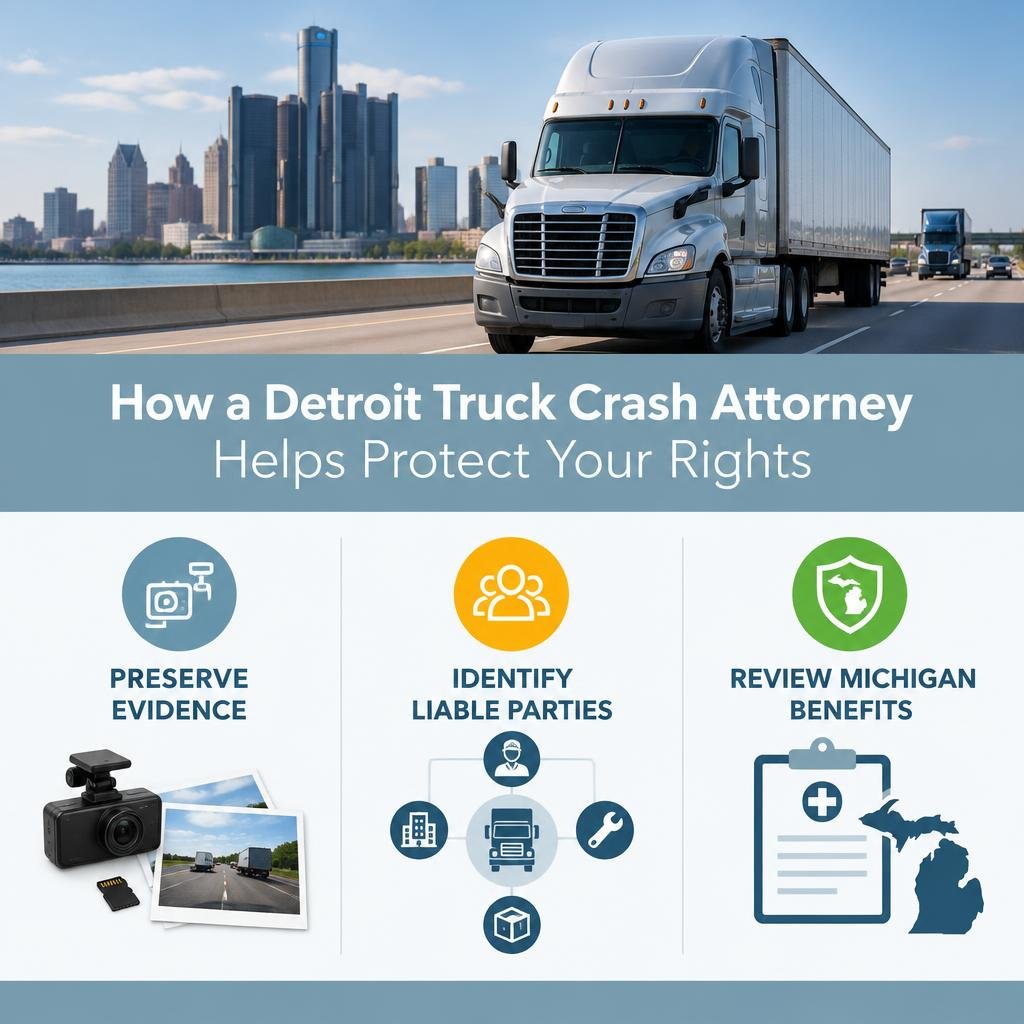
Detroit semi truck crash attorney terms at a glance:
Why Commercial Vehicle Collisions Differ from Passenger Auto Accidents
Collisions involving commercial tractor-trailers are fundamentally different from standard two-car crashes. In Michigan, there were recently 15,852 crashes involving commercial trucks, many resulting in severe or life-altering injuries. The extreme disparity in size and weight between a commercial semi-truck and a passenger vehicle often causes catastrophic trauma to vehicle occupants.
When a passenger car collides with an eighty-thousand-pound commercial vehicle, the physical forces are immense. Maneuvering around congested corridors like I-75, I-94, or I-96 requires long stopping distances that commercial rigs often cannot achieve when traffic slows abruptly. If you were injured in a heavy vehicle collision, consulting a Detroit commercial vehicle accident lawyer can help you understand the distinct legal and safety standards governing these carriers.
Unique Dynamics and Severe Injury Risks in Semi-Truck Collisions
A fully loaded commercial big rig can weigh up to twenty times more than an ordinary passenger automobile. Because of this massive gross vehicle weight rating, semi-trucks take significantly longer to come to a complete stop and transfer devastating momentum upon impact.
These collisions frequently take specific, hazardous forms, such as:
- Underride Collisions: A passenger car slides beneath the side or rear of a commercial trailer, frequently shearing off the passenger compartment roof.
- Jackknife Crashes: A truck driver brakes improperly or loses traction, causing the trailer to swing outward at a sharp angle across multiple lanes of traffic.
- Rollover Accidents: Top-heavy freight or sudden swerving shifts the vehicle's center of gravity, causing the trailer to overturn.
- Cargo Shifts and Spills: Defective load securement causes freight to shift mid-transit, pulling the cab out of control or discharging dangerous cargo onto the highway.
| Collision Factor | Passenger Vehicle Collision | Commercial Semi-Truck Crash |
|---|
| Average Operating Weight | 3,000 to 5,000 lbs | Up to 80,000 lbs |
| Required Stopping Distance | ~120 to 140 feet at 55 mph | ~300+ feet at 55 mph under ideal conditions |
| Typical Injury Severity | Moderate (whiplash, minor fractures) | Catastrophic (spinal cord trauma, severe TBI, crush injuries) |
| Regulatory Oversight | Standard Michigan traffic codes | Michigan Motor Carrier Safety Act & FMCSA federal rules |
| Primary Insurance Structure | Individual auto policy / Michigan PIP | Multi-layered commercial carrier policies ($1M–$5M+) |
Victims of commercial freight wrecks commonly suffer severe traumatic brain injuries (TBI), complex spinal cord damage, crushed limbs, internal organ trauma, or fatal injuries requiring wrongful death claims.
State and Federal Safety Regulations Governing Commercial Freight Carriers
Commercial truck drivers and interstate carriers are governed by comprehensive safety rules enforced by the Federal Motor Carrier Safety Administration (FMCSA) alongside Michigan-specific statutes. These strict standards dictate vehicle maintenance schedules, drug testing, and driver qualification files.
One of the most vital rules is Michigan's Hours of Service regulation. Under these standards, truck drivers must take a mandatory 30-minute rest break after eight cumulative hours of driving and cannot exceed a 14-hour duty window within a 24-hour period. Commercial drivers must also maintain valid commercial driver's licenses (CDL) and adhere to strict mobile device bans. Proving that a driver violated these rules is central to pursuing Michigan distracted driving truck accident claims.
Determining Liability with a Detroit Semi Truck Crash Attorney
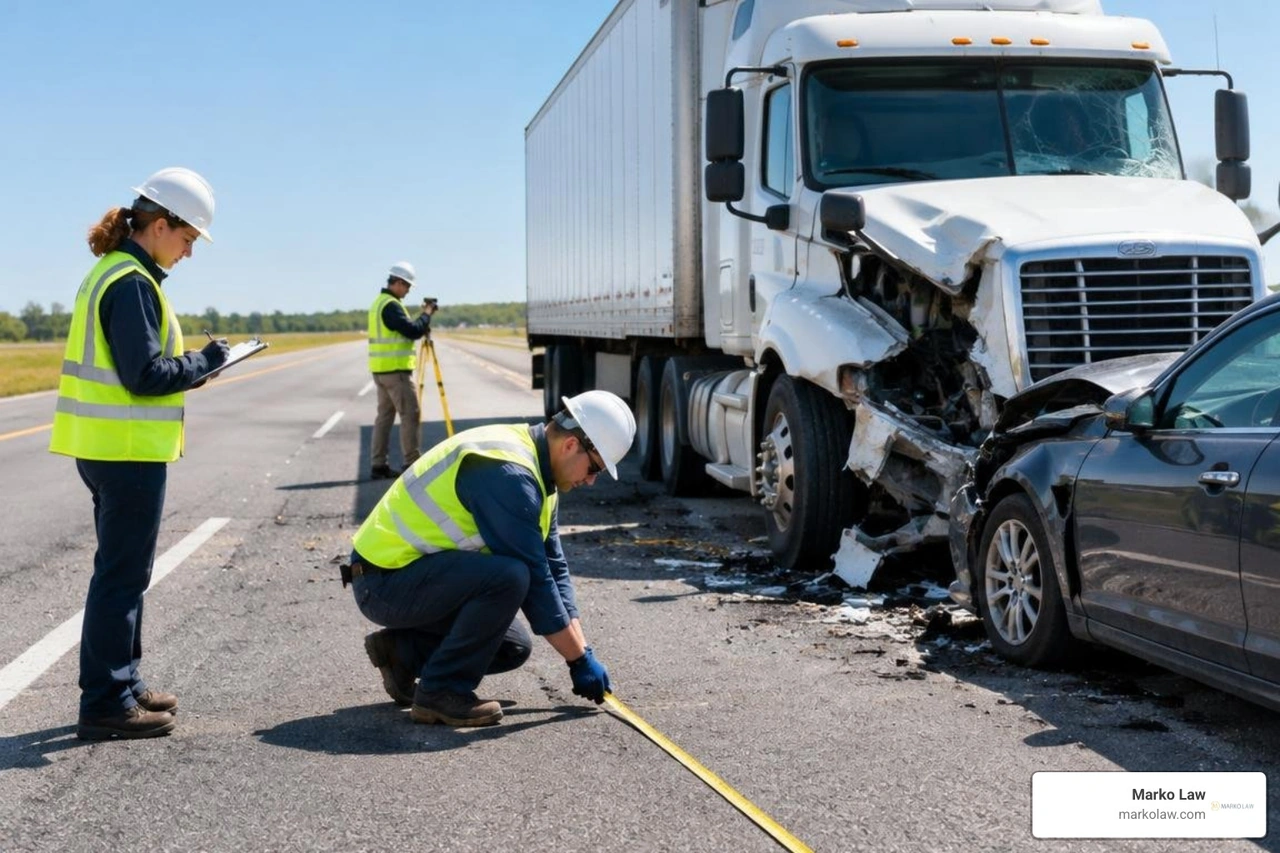
Proving fault after an 18-wheeler wreck involves far more than simply showing a driver made an error. A dedicated Detroit semi truck crash attorney evaluates the broader chain of corporate responsibility to identify every entity that contributed to the crash.
Under the doctrine of respondeat superior, trucking companies are often vicariously liable for the negligent actions of their drivers performed within the scope of employment. A carrier may also face direct liability for negligent hiring, inadequate safety training, or coercing drivers to violate rest regulations. Managing these corporate layers requires focused litigation, as detailed in our guide on navigating a Detroit truck accident lawsuit in Michigan.
Multiple Liable Parties in Commercial Trucking Claims
Unlike basic auto claims that focus on two individual motorists, commercial transportation operations rely on an interconnected network of businesses. Any breakdown in this operational chain can create legal liability:
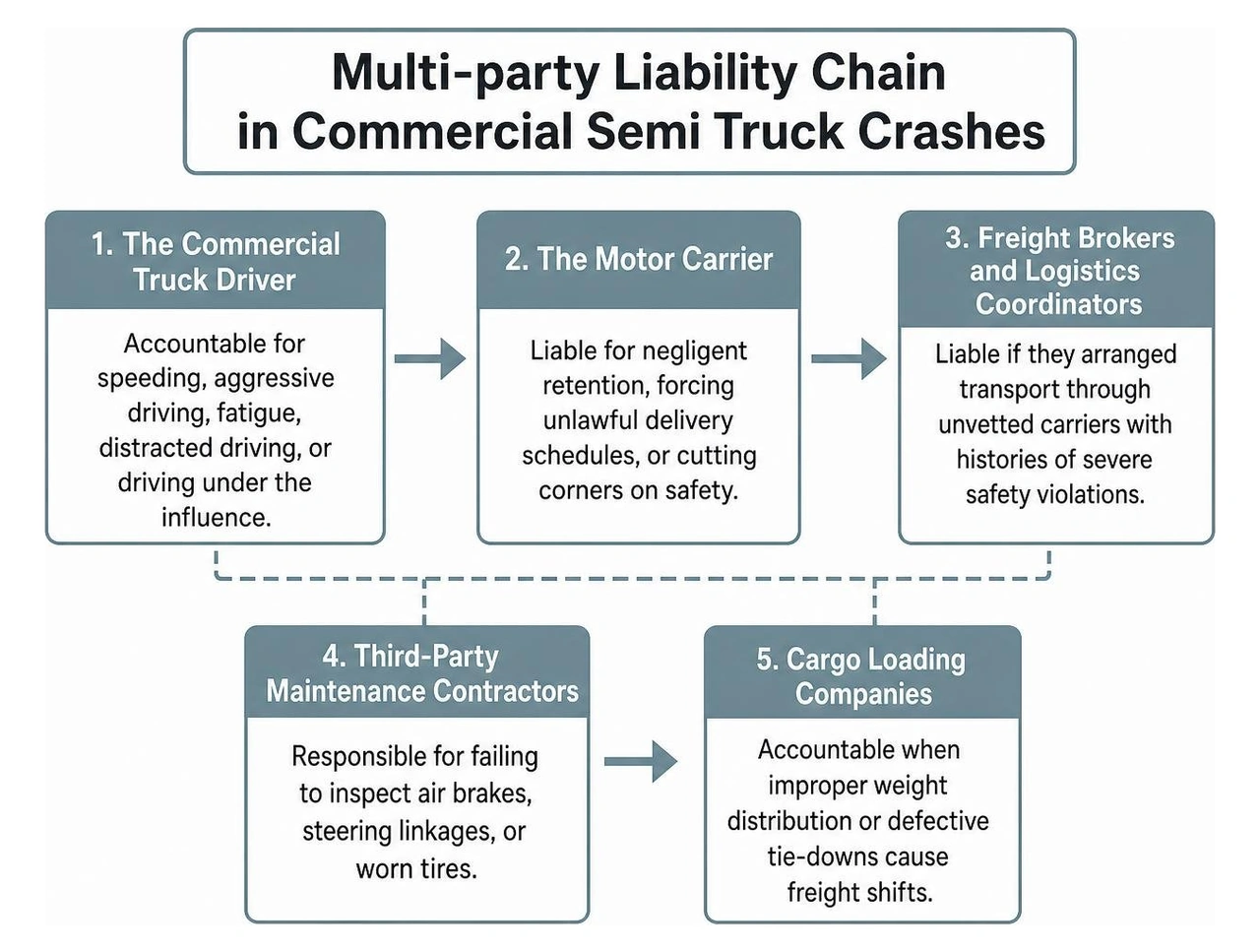
- The Commercial Truck Driver: Accountable for speeding, aggressive driving, fatigue, distracted driving, or driving under the influence.
- The Motor Carrier: Liable for negligent retention, forcing unlawful delivery schedules, or cutting corners on safety.
- Freight Brokers and Logistics Coordinators: Liable if they arranged transport through unvetted carriers with histories of severe safety violations.
- Third-Party Maintenance Contractors: Responsible for failing to inspect air brakes, steering linkages, or worn tires.
- Cargo Loading Companies: Accountable when improper weight distribution or defective tie-downs cause freight shifts.
- Manufacturers: Liable under product liability theories when defective brake lines, blowout-prone tires, or flawed underride guards fail.
Similar multi-party questions often arise in Amazon, FedEx, and delivery van accidents in Michigan. When municipal government trucks are involved, specialized notice rules apply, which our Detroit municipal truck accident lawyers manage regularly.
How a Detroit Semi Truck Crash Attorney Uses Black Box Data and ELDs
Modern commercial trucks are equipped with advanced telemetry equipment that acts as a digital witness. Electronic logging devices (ELDs) track exact driving hours, while engine control modules—commonly known as event data recorders (EDRs) or "black boxes"—capture critical vehicle data in the seconds leading up to an impact.
Did you know a commercial truck's "black box" is rarely black? It is typically painted bright orange or yellow to help investigators locate it in wreckage. This device records vital telemetry, such as:
- Vehicle travel speed immediately before impact
- Throttle percentage and engine RPM
- Precise timing and force of brake application
- Steering angles and abrupt maneuvers
- Seatbelt usage and fault codes
Because motor carriers often overwrite electronic data within weeks, your legal team must immediately issue formal spoliation letters. These legal demands prevent the carrier from destroying black box logs, dashcam footage, GPS data, pre-trip inspection reports, and dispatch communications.
Navigating Michigan No-Fault Insurance and Third-Party Lawsuits
Michigan's auto insurance system is distinct from most other states. Following a truck wreck, injured motorists must coordinate first-party Personal Injury Protection (PIP) insurance benefits with potential third-party tort claims against the negligent trucking company. Understanding how insurers build their defense is critical, as discussed in our review of Detroit truck accident defense tactics.
Personal Injury Protection Benefits Versus Third-Party Tort Claims
Under the Michigan Insurance Code, injured victims generally look first to their own auto policy (or a resident relative's policy) for statutory no-fault PIP benefits, regardless of who caused the collision. These benefits cover:
- Medical Expenses: Allowable medical costs, surgeries, rehabilitation, and long-term care up to the selected policy coverage cap.
- Wage Loss: Up to three years of statutory lost income reimbursement for time missed from work due to injury.
- Replacement Services: Modest daily compensation for household tasks the injured victim can no longer complete.
- Attendant Care: Payment for necessary in-home nursing or personal care assistance.
However, PIP benefits do not provide compensation for physical pain, emotional trauma, or loss of life enjoyment. To recover non-economic damages, an injured person must file a third-party tort claim against the at-fault truck driver and motor carrier.
To bring a successful third-party action in Michigan, the injured plaintiff must demonstrate they meet the state's statutory injury threshold: death, permanent serious disfigurement, or a "serious impairment of body function." Proving this threshold is crucial to securing a fair Detroit truck accident settlement.
Michigan Comparative Negligence and the Three-Year Statute of Limitations
Michigan applies a modified comparative fault rule in third-party personal injury lawsuits. Under this system, an injured victim's financial recovery is reduced in proportion to their percentage of fault. For example, if a jury determines your total damages are $1,000,000 but assigns you 10% of the fault, your recovery would be reduced to $900,000.
Crucially, if the plaintiff is found to be more than 50% at fault (51% or greater), they are legally barred from recovering any non-economic damages (pain and suffering) under Michigan law.
Timing is also critical. Under Michigan Compiled Laws Section 600.5805, the general statute of limitations for filing a personal injury or wrongful death lawsuit against negligent parties is three years from the date of the crash. However, claims for first-party no-fault PIP benefits carry strict one-year notice and "one-year-back" filing rules. Missing these statutory deadlines can permanently extinguish your right to compensation. You can read more about these rules in our Michigan truck accident guide.
Essential Steps to Take Following a Commercial Truck Collision in Detroit
The scene of a highway semi-truck accident is chaotic, but the actions you take immediately following an impact can make a significant difference in both your physical recovery and your legal claim.
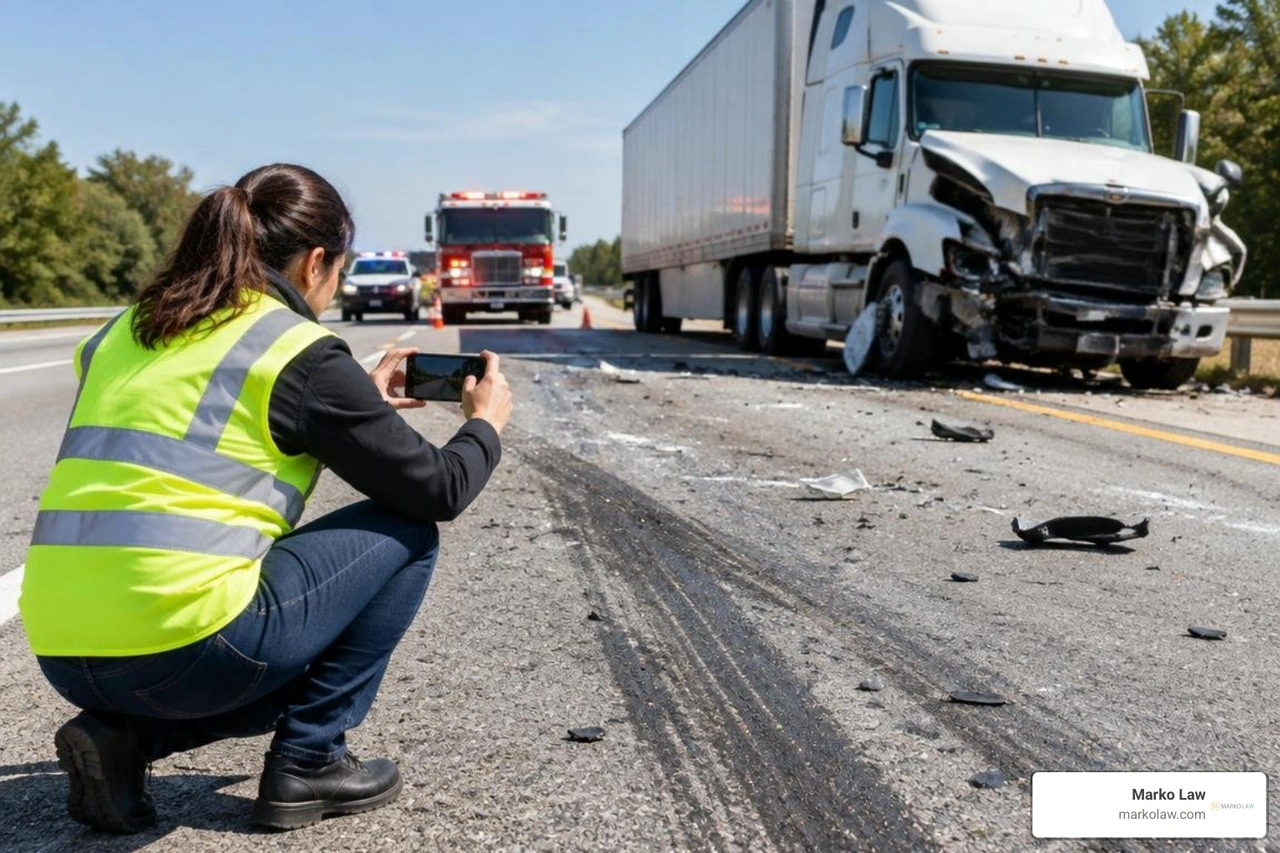
If you are physically able to do so safely, take the following steps after a collision:
- Call 911 Immediately: Ensure emergency medical services and law enforcement dispatch to the scene. Obtain the responding agency's crash report incident number.
- Seek Comprehensive Medical Attention: Accept an emergency room evaluation or see a physician right away. Many severe head, neck, and internal injuries do not manifest severe symptoms until hours or days later due to shock.
- Document Scene Evidence: Take photographs and videos of vehicle resting positions, damage, skid marks, road conditions, debris fields, and traffic signs.
- Record Commercial Carrier Identifiers: Photograph the truck's license plate, trailer numbers, and the USDOT/MC registration numbers stenciled on the truck doors.
- Collect Witness Details: Gather names, phone numbers, and addresses of any independent motorists or bystanders who saw the crash occur.
- Preserve Physical Belongings: Keep the damaged vehicle, torn clothing, and personal items in their post-crash condition without altering or cleaning them.
What to Avoid When Communicating with Insurance Adjusters
Commercial trucking insurers often dispatch specialized crash response teams and claims adjusters to the accident scene within hours. Their primary goal is to limit the corporate carrier's financial exposure.
To protect your legal position:
- Do Not Give Recorded Statements: You are not legally required to provide a recorded interview to the at-fault truck company's insurance adjuster. Statements can be taken out of context to argue you were comparatively at fault.
- Avoid Signing Blanket Authorizations: Do not sign broad medical record releases provided by third-party adjusters, which allow them to review your lifetime medical history in search of pre-existing conditions.
- Reject Early, Rushed Settlement Offers: Quick settlement offers made before you have reached maximum medical improvement rarely account for long-term care needs or future lost earnings.
- Stay Off Social Media: Refrain from posting details, photos, or updates about your health and daily activities on social platforms while your claim is pending.
Review our truck accident lawyer guide for additional insight into managing communications with commercial insurers.
Frequently Asked Questions About Detroit Commercial Truck Accident Claims
What damages can be recovered with a Detroit semi truck crash attorney?
Depending on the facts of your case, compensation in a third-party commercial trucking claim may include:
- Past and future medical expenses exceeding no-fault policy caps
- Lost wages and diminished future earning capacity
- Physical pain, suffering, and emotional distress
- Permanent disability, physical impairment, and scarring
- Loss of consortium and companionship
- Funeral and burial costs, along with lost financial support in wrongful death actions
Can I sue the trucking company directly if driver fatigue caused my crash?
Yes. If driver fatigue contributed to the collision, the motor carrier can often be sued directly for its own independent negligence. A carrier may be liable for setting unrealistic delivery windows that forced the driver to violate federal Hours of Service rules, failing to monitor ELD compliance, or ignoring past logbook violations.
How soon must a commercial truck accident lawsuit be filed in Michigan?
In Michigan, you generally have three years from the date of the collision to file a third-party personal injury or wrongful death lawsuit. However, first-party PIP claims require written notice to your insurer within one year. Because digital black box data and video evidence can be erased within weeks, you should contact legal counsel as soon as possible after the incident.
Conclusion
Commercial trucking wrecks on Detroit roadways present complex challenges involving corporate liability layers, federal safety codes, and Michigan no-fault insurance statutes. When facing powerful transportation companies and corporate insurers, having experienced trial representation helps ensure your rights are protected throughout the legal process.
Marko Law has a proven record of holding negligent trucking corporations and institutions accountable. To date, Marko Law has secured over $2 billion for their clients, including the largest single-plaintiff verdict ($896.5 million) and the largest premises liability verdict ($76.6 million) in Michigan history, as well as over $20 million recovered against the MDOC.
If you or a family member was injured in a commercial vehicle collision, contact an experienced Detroit semi truck crash attorney at Marko Law today. We handle cases on a contingency fee basis, meaning there is no fee unless we win.
Call our Detroit office today at 313-777-7777 or visit our contact page for your free, confidential case evaluation.
Disclaimer: The information provided in this guide is for general educational purposes only and does not constitute individualized legal advice. Reading this article does not establish an attorney-client relationship. Legal outcomes depend on the specific facts and circumstances of each individual case.